Fair Food at 13 Years

From February 19th – March 4th in the year 200, Students from across the state of Florida and youth groups answer a call to action and walk alongside the farmworkers from Immokalee Florida in the “March for Dignity, Dialogue and a Fair Wage.” The first action outside Immokalee, the march covered 243 long miles to the Florida Fruit & Vegetable Association. Marchers walked from sun-up to sunset (9-10 hours a day) for 15 days straight.
This led to the amazing social movement that became the Coalition of Immokalee Workers, Student Farmworker Alliance, Taco Bell Truth Tour, Actions at Yum Brands’Annual Shareholder Meeting, McDonald’s Truth Tours, and so much more (see a timeline here). The CIW has become the vanguard of new social movements in the United States alongside the Right tot he City Alliance, the Workers Center Movement, Take Back the Land and the Domestic Workers United.
Now they are taking that walk again. On 3/3/2013: Join them in the streets again for the two-week “March for Rights, Respect and Fair Food” from Ft. Myers to Lakeland, Florida! Details are here ciw-online.org.
A Tale of Two Thanksgivings
A message from the Coalition of Immokalee Workers:
This holiday season, ask Publix to join us at the Fair Food table…
The holiday season is upon us, which means it’s time again to gather around the table with loved ones to celebrate another year of life together, of new beginnings and old friends, of triumphs and of the challenges ahead.
The holiday table unites us, and reminds us that — no matter how high, or low, our day to day lives may take us — in the end, we always make our way back to those whom we love the most, and when we are with them, the world feels right.
Love is the essence of the holidays. Love for our parents and their parents, love for our children and their children. Love for our friends, and love for all men and women with whom we share this fragile world. The holiday table reminds us that, in the end, we are all family, and that we can only truly enjoy the bounties that life gives us if we all enjoy them together, as one.
No one knows this better than Publix. Its holiday commercials are a tour de force in touching that place deep inside each of us that loves not just our families and friends, but our fellow man, too, regardless of the divisions that may separate us in our daily lives. Publix commercials never fail to remind us just how much we have to be thankful for, and how powerful an emotion our love can truly be.
But love without goodwill is an empty emotion. And, sadly, the holiday season has become an annual reminder that Publix — a company founded by a man, George Jenkins, who famously said the words “Don’t let making a profit stand in the way of doing the right thing” – is a company that has lost its way. Like any family, the families who own and run Publix gather around their holiday tables and reflect on their joys and struggles. For the families who run Publix, among those joys, year after year, are soaring profits. Yet they inexplicably continue to turn their backs on the farmworkers who make those profits possible.
Check out the CIW website for the powerful new video, A Tale of Two Thanksgivings, and an accompanying online petition to send a holiday message from the Fair Food nation to Publix!
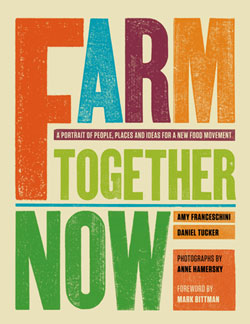
Gastronomica Reviews Farm Together Now!
Review: Farm Together Now: A Portrait of People, Places, and Ideas for a New Food Movement by Amy Franceschini and Daniel Tucker, with photographs by Anne Hamersky
San Francisco: Chronicle Books, 2010
192 pp. Illustrations. $27.50 (cloth)
by Naomi Starkman for Gastronomica: The Journal of Food and Culture – Vol. 12, No. 3 (Fall 2012), pp. 117-118 Published by: University of California Press. JSTOR Stable URL.
If the country’s good food movement continues to thrive, it will be largely due to our nation’s farmers—the original futures investors engaged in an often precarious practice of endless beauty and decay, triumph and loss. As the new book Farm Together Now clearly conveys, this movement for real food and sustainable agriculture is comprised not only of farmers but also of urban activists, seed savers, beekeepers, and the many other groups who are building gardens to build communities and growing food to promote justice, some on borrowed land or borrowed time. Showcasing twenty of these American heroes, artist and designer Amy Franceschini and organizer and documentary maker Daniel Tucker—aided by the arresting photographs of Anne Hamersky—create a tapestry of the visionaries who are making a new food system.
In the first chapter, “Organizing Alongside Conventional Farmers,” we travel with our guides to rural Nebraska and encounter third-generation animal farmer Jim Knopik, who turned his own farm—and his neighbors—against factory farming in launching the statewide Nebraska Food Cooperative. We then meet third-generation Wisconsin dairy farmer Joel Greeno, who has been milking cows since he was ten years old and is now the president of the American Raw Milk Producers Pricing Association, an organization of dairy farmers dedicated to establishing raw milk prices that return dairy producers their cost of production plus a profit. The story of this food movement involves not only those working with the system; it also centers on individuals who are creating new structures. Take, for example, the farms the authors feature in the chapter titled “In Intentional Community”: Sandhill Community Farm in Rutledge, Missouri; and Tryon Life Community Farm in Portland, Oregon. Both groups are building communities based on biodynamic, cooperative, and egalitarian principles.
The book moves on to chronicle the “policy shapers” who are transforming the inner city. Urban farmers at Oakland’s City Slicker Farms—which sells produce for every budget— and Angelic Organics Learning Center in Chicago—one of the largest community supported agriculture (csa) farms in the country—both fit the bill. They are sprouting not only new urban gardens, but also supporting programs to improve their local food systems by changing the way their communities gain access to good food. In “Up and Out of Poverty,” we are similarly schooled in the hard work of the Georgia Citizens Coalition on Hunger, whose programs grew in response to the lack of healthful food in Atlanta’s primarily African American neighborhoods. An advocacy project cum food pantry and support group, the organization now grows its own food for sale at farmers’ markets.
The book shines a light on the next generation of farmers, such as the team at Freewheelin’ Farm in Davenport, California, who aim to shrink their footprint at every turn, including delivering csa shares by bicycle to their subscribers. In Union Pier, Michigan, we are inspired by anarchistorganizer, fair-trade coffee roaster, and avid tax-resister David Myers, whose On-the-Fly Farm csa subsidizes low-income subscribers and who shares donated farmland with God’s Gang, a nonprofit organization that provides access to good food for displaced residents of the Chicago Housing Authority.
Along the good food road, we meet farmers saving seeds in Arizona and others producing heritage wheat in New York. We meet a sixth-generation acequia farmer who irrigates his land from the oldest “water right” in Colorado, a practice heralded as “water democracy.” We follow up with the South Central Los Angeles Farmers, whose riveting story of displacement was told in the documentary film The Garden and who have since reinvented themselves in Bakersfield, California. Finally, we are invited into the rare world of a radical beekeeper in New York’s Hudson Valley, whose goal is to rebuild the dna of the honeybee to strengthen it to resist disease. They, and many more, farm together now.
With numerous digressions and detailed research, Farm Together Now offers much food for thought to readers both well versed in and relatively new to this movement for change. Its greatest strength is in giving voice to the creative solutions and myriad moving parts that comprise our food system, all of which are inspiring a sea change against the industrial food machine.
—Naomi Starkman, Cofounder of CivilEats.com
Farm To Table via USPS
How food distribution works today with endless middle men, warehouses, distribution and packaging companies, wholesalers and grocers is not the way things have always worked. Our friends recently shared some surprising history about a food by mail system that could point to possibilities for revitalization of the postal service and the food system today! It all began in 1896 when the Rural Free Delivery Program was started and in 1913 it was connected to the postal service. The program thrived throughout World War 1 but fell victim to competition from the private sector as time moved on. Additionally, the construction of highways changed the way transportation of people and goods occurred throughout the country. As a policy experiment it was innovative, risky and bold. We need to see more of that if anything about how the food supply and distribution chain works. For information about workers who are organizing across the “food chain” check out the important work of Food Chain Workers.
[Thanks to Lisa Junkin and Heather Radke for sharing these links.]
Gaza Kitchen Book
An old friend living in Madrid, Maggie Schmidt, and her collaborator Laila El-Haddad have just released their book “The Gaza Kitchen: A Palestinian Culinary Journey” for pre-order.
Here is what their publisher says about the project:
The Gaza Kitchen is a richly illustrated cookbook that explores the distinctive cuisine and food heritage of the area known prior to 1948 as the Gaza District—and that of the many refugees from elsewhere in Palestine who came to Gaza in 1948 and have been forced to stay there ever since. In summer 2010, authors Laila El-Haddad and Maggie Schmitt traveled the length and breadth of the Gaza Strip to collect the recipes presented in the book. They were also able to build on the extensive knowledge that Laila, herself a Palestinian from Gaza, had gained from family and friends throughout the years.
The 130 recipes presented in this book have all been thoroughly kitchen-tested. Amounts are presented using U.S.-style measures, and the authors suggest alternative ingredients and recipe adaptations for cooks working in the United States or other countries where some of the ingredients may not be easy to find. Numerous illustrations help readers understand how to perform the listed techniques—and what the finished product should look like!
But The Gaza Kitchenis not only a cookbook. A lot of other things happen in the kitchen as well as cooking: conversations, the re-telling of family histories, and the daily drama of surviving and creating spaces for pleasure in an embattled place. In this book, women and men from throughout Gaza tell their stories as they relate to cooking, farming, and the food economy: personal stories, family stories, and descriptions of the broader social and economic system in which they live.
When Laila and Maggie launched this project in 2009, they wrote:
Why do we want to talk about food and cooking?
Because food is the essence of the everyday. Beyond all the discourses, the positions and the polemics, there is the kitchen. And even in Gaza, that most tortured little strip of land, hundreds of thousands of women every day find ways to sustain their families and friends in body and spirit. They make the kitchen a stronghold against despair, and there craft necessity into pleasure and dignity.
Gaza has a rich food tradition and a unique cuisine combining Levantine and Egyptian elements. The history of its population can be traced through its recipes, which reflect the influence of exile from all over Palestine as well as a changing society and customs. A cookbook which brings together these recipes serves as testimony to this heritage and history.
What is more, today’s kitchens can tell us much about the difficult and paradoxical realities of Gaza after 3 years of unrelenting siege: which products are available and where they are coming from (tunnels, local agriculture, humanitarian relief), how cooks manage with extreme shortages of gas and electricity, how families reorganize to compensate for destroyed homes and near-universal joblessness. To spend a day with a Gazan woman doing the shopping and cooking is to understand the Palestinian reality from an entirely different – more material, more intimate – perspective. It is to appreciate the strength and endurance which allows these women every day to confront a hopeless situation and to create within it small spaces of grace, beauty and generosity.
Just World Books is honored to have been able to work with Maggie and Laila in the preparation of this unique contribution to the study of the world’s food heritage.
Every so often I get up the guts to attend, and even present at, an academic conference. I say this takes guts because to put yourself through multiple days of people reading papers and showing power points can be a unique form of contemporary masochism. Still, it is one of the few places where you can quickly hear a bunch of people from a bunch of places, quickly summarize their work and research. In the case of urban planning conferences, you can literally take a trip around the world in an hour and a half.
Last week I attended Cities Are Us: Rethinking Urban Inclusion organized by the CES in Coimbra, Portugal. There I attended a panel discussion about “Greening the City” with a collection of academics from all over the place. The presentations dealt a lot with dichotomies present in urban food production – such as informal vs formal. The talks pointed out how many diverse practices can fall under something we are now calling “urban farming” and they have as much in common as they do not – ranging from activist projects of young people and the unemployed, to elderly people to immigrants bringing their diasporic traditions to new home countries, and post-colonial urbanization of formerly rural people.
Portugal was a great place to have this discussion, because it is an agriculturally rich country where people have maintained a strong connection to the land. Additionally, the immigrant population from former colonies have really maintained their agricultural traditions. For your view reading pleasure and for me to remember what I heard, here is a summary of some of the folks and places I was introduced to in this panel:
Lisbon – Juliana Torquato Luiz, from the CES in Coimbra, uses a social-science lens to research gardens in Lisbon. In looking at the international discourse around farming, she has observed that there is a generalized rhetoric and lens that focuses only on “best practices” but leaves out critique and narratives about conflict. thus has decided to have a very local focus. Lisbon has innovated a great deal around “green public policy” through their “Piano Verde” plan. This plan, like most plans, involved creating a framework for what is and is not included in the city’s official garden map. Her research includes groups that have tried to respond to some of these challenges of what is/isn’t on the green map: the RAU (Portugese Network for Urban Agriculture), AVAAL Allotment Garden Project and the Assemblia Movel em Hortas Urbanas (Mobile Assembly in Urban Gardens) who have tried to use the platform of urban ag to organize neighborhood groups focused on larger urban issues.
Maputo – Leonardo Veronez de Sousa, from Coimbra, focuses his research on the Portugese “Colonial City” of Maputo. Following the civil war, which was stronger in the countryside, people’s relationship to land was changed. He believes that the peri-urban agriculture here can be a model for land occupation in other Western countries. The agriculture is organized through associations, 6 of which he has visited for his research. This has emerged as a real economic development tool, with lots of food being consumed domestically as well as exported to South Africa.
Rome – Giovanni Attili (shared examples of activist-initiated urban gardens that exist in parallel to the RomaAgra zone that lies outside of the city limits. Some of the examples included: In 1992 the Gartabella garden was instigated when the “Piano Gerace”, a formerly private plot of land, was pushed into public access by a longterm political campaign by the neighborhood that was completed in 1999. Eutorto is an urban garden oriented around supporting a collective of “former workers” supporting themselves in the face of long-term unemployment. Finally, we heard about Sculo Vive, an organization of people with disabilities, that instigated their own garden. His warning with researching informal gardens and activism is that the informal can sometimes lead to a celebration of informal in-and-of-itself through romantic description and urban populist ideology (they do not question the status quo). He claims that “city from below” type frameworks sometimes obscure the differences between various practices.
Hanoi – Le To Luong, a student in Germany, presented on park planning in Hanoi, Vietnam. Vietnam has, like most countries, rapidly urbanized, with a huge spike from 1996 onward from 20% of the population to 50% of the total population in 2010. This has resulted in the loss of Urban Green Areas (UGA). Her research focuses on the “lifestyle” changes that have accompanied this shift. She looks back to 1848 when there was an emperor, and there were no “public parks” (they were gated), then after French colonization they introduced some French-style parks that were not immediately warmed to, though now they are so overused those same parks have become in short supply. With the rise in elderly population, she expects these future retirees will only increase that demand.
Dondo – Mozambique is a former Portuguese colony and thus appropriate as a focal point for Céline Veríssimo, a researcher from Portugal working in the UK. As the country has shifted towards a neoliberal (deregulation and privatization), the informal settlements have grown immensely. She uses a “political ecology” lens to look at the residents approach to food production, increasing in response to growing food insecurity. In order to survive, formerly rural peasants/residents with an “innate connection to nature” have attempted to recreate the countryside food production, shade trees and fruit trees in the city – on the edges of the traditional core “concrete city” (most of the informal settlements are not built from cement, so it has a quite different form of organization and aesthetics. She estimates that 89% of food production in the city is informal, and most of that is happening in people’s commonly held yard space. The so-called “slums” have an incredibly pleasant appearance that is very green, shaded, and encourages an active social life much more intensely than in the core city. Her research has concludes that these “new modes of production are combined with ancient knowledge based on a socially and ecologically regenerative model of society.” She thinks these practices can “increase urban resilience” in the face of austerity and ecological crisis but in order to expand it will require “institutional, scientific and professional support for a democratic and ecological urban paradigm shift.”
Rio de Janerio and Lisbon – Marianna Monte does a comparative analysis of public gardens and markets in these two historically linked cities. She argues for social criteria to be used in who gets permits to do urban gardening in a case study in Lisbon – but now that is not the case, it is essentially first come and first serve. The same applies to legal street vendors in Rio, which have experienced since the 1990s a formalization of the popular market area. This is particularly interesting at this time because Rio is hosting the World Cup in 2014 and the Olympics just two years after that. So their land-use policies need to be watched carefully.
It is hard to go in very deep to any of the places in a 15minute presentation, and much harder in my attempt at summary. Still, I hope you enjoy the whirlwind tour and follow-up with some of these promising young researchers. As they say, Obrigado! - Daniel Tucker
[Acknowledgements: Thanks to the conference organizers, the chair of this panel Stefania Barca, and University of Illinois at Chicago for supporting my travel.]
Marketing Together Now
Farmers wear many hats. Not just wide-brimmed straw hats, baseball caps and wool beanies for the winter – many professional hats.
Yes. It’s very easy to think of your farmer as someone who just grows the seasonal delights you tote home in a CSA box or your farmers’ market basket. But growing food is only the tip of the iceberg lettuce when it comes to the laundry list of skills that one needs to run a small farm. A small farm is, after all, a small business and growing food is just a piece of the pie. The smiling, tan farmer who hands you your bag of spinach or dozen eggs does so much more than just grow food. She or he also serves as chief marking officer, along with a laundry list of other non-production oriented responsibilities.
Many folks are drawn to the farming life to work close to the land and nourish their community with delicious food. Undoubtedly, for some there is something so rewarding about laboring outside, toiling daily to the point of exhaustion and cultivating a product with your own hands (or hoe or tractor). However, getting your products ‘to market’, and actually selling it, is just as important as growing and raising the delicious edibles themselves. And for producers selling directly to their customers, sometimes it can feel like a marketing degree is required to actually sell anything. Just consider the branding, packaging, website, market signage, advertising, social media, CSA member signup, travel to the market and newsletter writing stands behind the food you buy. Ultimately though, the business end of the enterprise is only sustainable when the product actually finds a paying home. Sometimes growing food can be the easy part in comparison, and marketing activities take a big bite out of the time growers would like to spend in the fields (or sleeping at night), not to mention a chunk of the budget too.
Gratefully, there is a groundswell of support from local and national organizations, individuals and institutions all who want to provide some sort of market opportunity, advertising or educational benefit to support small, local farms. As a consumer, it’s easy to think about websites like Sustainable Table, publications including Edible Communities (be sure to look up the nearest to you) or online databases such as Local Harvest as an easy way to find a local farm or learn about the benefits of sustainable agriculture. From the grower’s perspective, these are advertising outlets and campaigns that help boost a market demand for their products. And thank goodness, resources now include everything from CSA coalitions, searchable databases of local farms, food hubs, websites promoting the environmental and health benefits of eating local and many more. You may call it Marketing Together Now, but it’s just another way people who believe in local agriculture join forces to increase opportunities for farmers and consumers.
Here’s just one example. It’s 2012, and the Community Supported Agriculture (CSA) concept is becoming more and more common, almost mainstream. In this model, customers ‘join’ a farm, pay the farmer at the beginning of the growing season and then receive regular ‘shares’ of the farm produce regularly throughout the season. Farmers receive much needed cash flow at the beginning of the growing season, CSA members share in the risks of farming and food can be harvested with the knowledge of exactly where it is going.
In the early 1990s, just a handful of US farms operated as CSA farms, and the concept was unfamiliar to consumers. In the beginning, farmers and local food advocates collaborated to educate the community about this new model, planting the seeds for future success. By 1999, these community efforts to enthuse potential customers blossomed, with an estimated 1000 CSAs taking root across the country. And the groups organizing around CSAs grew too. Many became official organizations with a mission to promote CSAs and provide a community for producers too. Their work is instrumental in the rapid growth of community supported agriculture, with 4,571 CSAs listed on Local Harvest at the beginning of 2012.
MACSAC is a perfect example, but you can see them in Portland (PACSAC), Kansas City, New York City and Dubuque. Now they are non-profits, farmer lead, or have a small staff – but are close to the farmers.
A CSA Coalition may play many roles. Most are membership groups, loosely or formally organized, with the mission to promote CSA farms and provide community for farmers. Many promote the concept of CSAs and educate about their benefits. Some of these organizations go further, hosting annual CSA sign-up events, a chance for people to meet their farmers and sign up for a share in person. Some raise funds to subsidize shares for those who can not purchase a CSA at full price. Others organize classes on cooking or food preservation. The pinnacle of positive work is by the Fairshare CSA Coalition of Wisconsin. They partnered with local health insurance companies, encouraging them to offer rebates to those who join CSAs.
The work of a CSA Coalition is not just for the consumers, many provide a way and a place for farmers to gather, unite, have fun and learn through workshops, listserves or events. This is the nature of good food, built on a strong foundation built by growers and eaters alike – while providing much needed ‘professional services’ to make farms more visible too!
Is there a CSA Coalition or Network in your area?
Dubuque CSA Coalition
FairShare CSA Coalition
Kansas City CSA Coalition
Just Food CSA Network
Hazon CSA Network
Portland CSA Network

