Farm Together, Now?: A Fifteen Year Reflection
Farm Together, Now?: A Fifteen Year Reflection
By Daniel Tucker
“Every minute I speak to someone like you, that’s that many minutes I’m not perfecting my life philosophy.” That’s the greeting I got when I traveled nearly 700 miles to visit and interview a farmer back in 2009 for the book “Farm Together Now: A portrait of people, places and ideas for a new food movement” (Chronicle Books, 2010). Whew, I thought – I appreciate the clarity of purpose but as a greeting it was rough.
We went on to spend the day together and I started to see more about this tension. He really just wanted to work on his plants and refine his methods, but there was a tremendous pressure to represent himself to others. That was particularly prevalent at the time – just as food was getting fancy and organizations were cropping up to educate people about how the food systems could be more just and sustainable. Many food activists prefigured the lifestyle influencer route, spending more and more time doing the representing of the work that took them away from “the work” itself.
In working on the book a related phenomenon that became apparent was the way that many urban gardens were encouraged to overstate their effect, often using the admirable frameworks of food sovereignty and justice, to describe projects that materially had little impact on the local food system, while having all sorts of other impacts that went unmentioned. This was likely a practical solution to funders that encouraged such transformational rhetoric, but in many ways obscured the fact that what most urban gardens do is get a small number of people outside and spending time learning and exchanging with neighbors and building skills and confidence. But they were not changing complex and hardened aspects of food chain distribution networks. The unfortunate trade off was that it was harder to understand what those projects really did accomplish – which was a lot, but just not what they said in their mission statements, grant applications and social media posts!
And so Farm Together Now came out and we did a national book and press tour and did our own representing. And I kept thinking about that awkward greeting and what lessons it held, for me personally, for the food movement and also for people trying to enact change more broadly.
What I started to realize for myself, was that this tension between the doing and talking or representing and the pressure to overstate the impact of one’s work, this was a problem that had some unique similarities (and potential solutions) in my field of origin which was art. And so while I was eager when I was co-creating Farm Together Now with my collaborators to step out of art and engage in food (a field I thought was more fundamental to life), it started to pull me back in. I realized that through the lens of this tension that art and farming surprisingly shared some problems, and that when such correlations present themselves it’s worthwhile to think about how they can be brought in dialogue.
My next book, Immersive Life Practices, set out to explore this question. It was released 10 years ago (SAIC/University of Chicago, 2014) and looked at art projects that tried to blur the line between the doing and the representing. This re-investment in art also had a marked influence on how I engaged with food systems for the following decade – developing curatorial projects featuring art about the logistics and distribution of food, as well as ecology and bioregionalism more broadly.
In retrospect, there is a strong relationship between art and farming. I’ll attempt to outline a few here:
- The kind of food and art we get when utilizing market-based value systems is predictable and boring.
- Growing food, making art, sharing food and experiencing art – these activities do a lot for our well being that are difficult to articulate. The framework of intangible cultural heritage could apply to both, if it was expanded to include more contemporary practices in each field.
- There are forms of both art and food that are more introspective and draw on an individual’s hard work and exploration of the capacity of self, and there are forms of both art and food that are all about systems and social dynamics. It is hard for both fields to account for that wide spectrum of practices and forms, but the bigger the tent – the better.
- Art and food culture both suffer from a kind of alienating self awareness/referentiality – did you go to this restaurant or this museum and follow the dots between this chef or this curator. But sometimes we just encounter art or a meal and want to appreciate it through other lenses. These can be aesthetic experiences embedded in everyday life that connect us to places and one another, make beauty accessible and reclaimed from the market logic and disciplinary boundaries that encourage these alienating ways of communicating. We all deserve transformative experiences with food and art and nourish us!
- Because food related organizations and art related organizations often end up prioritizing education, they have an opportunity to contribute more to conversations about informal, collaborative, self-directed and process-based learning. A barrier is that they don’t often express this as their primary goal, because their fundraising priorities pull them in so many directions (to the farmers, say you’re transforming the food system; to the arts administrators – say you’re changing the world through art). This pressure to overstate impact can distract from a more precise grappling with what the work is and what it achieves.
- And finally, one of the things that I appreciated the most about talking to farmers across the country was that clarity of purpose I mentioned earlier, which is the kind of thing that leads people to say something like “Every minute I speak to someone like you, that’s that many minutes I’m not perfecting my life philosophy.” This binds farmers to artists, who are very conflicted between making/doing and showing/talking. Not only is this a potential bond to connect their outputs, but it also offers an expanded peer group to help them think through how they want to do their work and structure their lives.
As I think back about crisscrossing the country with my collaborators Amy Franceschini and Anne Hamersky interviewing and photographing activist farmers from the red clay under the urban skyline of Atlanta to the drought resistant seeds of the desert Southwest – I feel immense gratitude for who we met and what they shared with us. In some cases it was an afternoon interview and a tour, and in others it was a meal and overnight camping on their land. Some we visited only once, others we continue to stay in touch to this day. In every case they offered some access to their collaborators, staff and community members to help us get a sense of the larger world around their farm. And in our conversations they brought us into their pre-histories, their proud current achievements, their challenges and their hopes for the future.
If we were to do a sequel book, we’d have some new questions and as some of the farms have closed – we’d probably look at some new farms while revisiting some from the first book. The accessibility of robotics, the altered public policy landscape, the growth of distribution hubs to support regional economies, the focus on equity in land ownership, dramatic changes to growing climate and weather – are just a few of the new lines of thinking and work that farmers today have been grappling with that I imagine we would delve into. For now, I cherish the lessons learned and hold out hope for more art and food collaborations. They truly are the nourishment I live for.
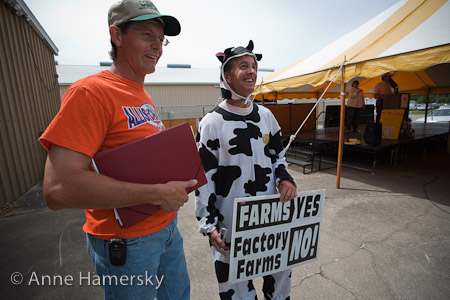
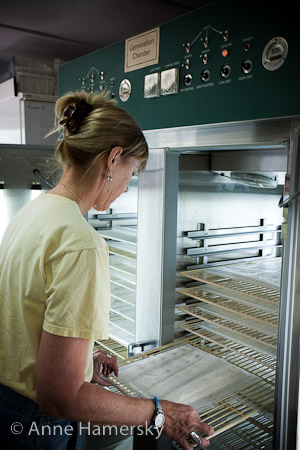
Note: All Photos courtesy of Anne Hamersky for Farm Together Now (Chronicle Books, 2010)






 Farm Together Now - The Book and Blog