Antibiotic use in animal production
Antibiotics have been used in industrial animal production for over fifty years. Recommendations to reduce or eliminate the use of antibiotics in animal feed have been made repeatedly over the last thirty years. The widespread use of antibiotics to accelerate growth among livestock and to compensate for the unhealthy conditions found in confined animal feeding operations (CAFO) has led to an increase in antibiotic resistant strains of bacteria.
The Preservation of Antibiotics for Medical Treatment Act H.R. 1549/S. 619 means to limit the use of antibiotics in food animals. The latest version of this bill was introduced last year by Rep. Louise Slaughter. Earlier this month, the third and final Congressional Hearing was held on antibiotic resistance. Dr. John Clifford, Deputy Administrator for Veterinary Services for the USDA’s Animal and Plant Health Inspection Services (APHIS) stated in his testimony that it is likely that the use of antibiotics in animal agriculture does lead to some cases of resistance in both humans and animals. The FDA has recently stated that using antibiotics for animal production purposes is not in the interest of protecting and promoting public health.
The FDA’s approach to Antibiotic Regulation is explained here by the Union of Concerned Scientists. While the Center for a Livable Future submitted a written statement to the House Committee in which to make recommendations for Congressional action. CBS evening news recently reported on this issue, included are clips from the Congressional Hearing. Katie Couric reports that the FDA, CDC, and the Department of Agriculture are all now urging farmers to stop the feeding of antibiotics to healthy livestock.
It is estimated that food animals consume almost 70% of the antibiotics administered in the United States–almost 25 million pounds per year. PAMTA would ban the non therapeutic agricultural use of antibiotics that are particularly beneficial to treating human illnesses. Over 300 health, consumer, and environmental organizations nationwide support the passage of this bill.
PAMTA is pending in Congress.
Endpapers
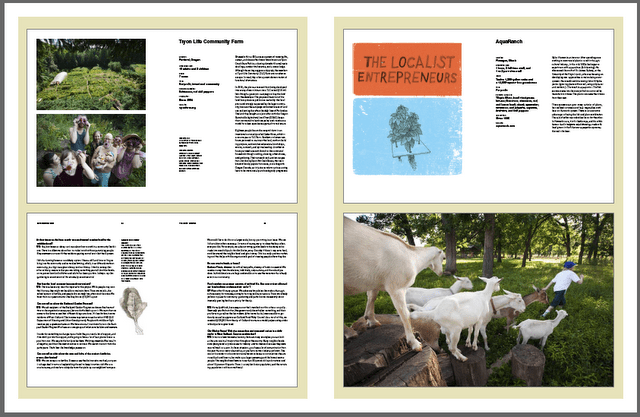
Here are the endpapers designed by Brian Scott of Boon Design firm in San Francisco who is the mastermind behind the layout of Farm Together Now. These papers will open up the book and give readers a taste of all the amazing people we met on our trip across the U.S. (All photos by Anne Hamersky):

Sell Sheet for FTN
Here is the promo “sell sheet” for Farm Together Now, just in from our publisher Chronicle Books:

Letter from Joe Hollis at Mountain Gardens

Joe Hollis at Mountain Gardens
Our photo wizard Anne Hamersky received this letter from Joe Hollis, one of the farmers featured in Farm Together Now:
Hi Anne,
I’m glad to hear from you. Daniel has alerted me to the book’s progress, and I am very much looking forward to seeing it. I looked through the new website and noticed the back-to-back ‘gorgeous book’ comments. I love the photos you sent of me and Steve and am eager to see what else you’ve chosen.
There is quite a lot going on here, very productive year so far. Six apprentices plus usually a WWOOFer or two. Best group of apprentices ever. We’ve got a large food garden planted and moving along with Chinese herb and native wildfood projects. The big excitement at the moment is wasabi: after about 20 years, starting with one plant, I now have about fifty large flowering specimens and a thousand seedlings, and I’m about to launch a wasabi industry in the area. The greenhouses, coldframes and many spots in garden are filled with a beautiful violet-magenta mustard from China which I randomly acquired years ago. The flowers are big and bright and tasty, as are the greens; and this year I’m trying to grow a really big crop of seeds. I think this plant will be in every seed catalog in five years. The apprentices have about finished a new Steve dome, and one is set to move in – he’s a mushroom man, so we’re growing mushrooms of many kinds all over the place.
This is looking like the year in which many projects which I’ve been working on for 15-20 years are coming to bearing fruit, and the book will be a big part of the overall Mountain Gardens project coming to fruition.
And it has been the best spring in my memory for the plants: some close shaves, but no killing freezes. Plants I established 25 years ago are going to bear fruit for the first time. I’ll write about all this and attach pictures for your blog (and mine) as soon as the spring rush subsides.Joe
Joel Greeno and Anne Hamersky
Anne Hamersky, the wonderful photographer we chose to work with on Farm Together Now had one of her photos from the book selected for the American Society of Media Photographer’s Best of 2010 show.

Joel Greeno, Wisconsin Dairy Farmer and Community Activist
Here is what she wrote about the image:
A year ago, my friend Amy Franceschini asked me to shoot some West Coast farms for a book about sustainable agriculture around the United States. Yes, definitely, this is my passion, but I had one request. I wanted to shoot all the farms, across the country. Happily, she gave me the green light and I had my dream project. No need to mention the insane deadline, I was thrilled.
I pieced together a jigsaw puzzle of sixteen farms and 13,000 miles of connecting roads, mapping a big loop around the continental United States. I fit harvest schedules into my own furious timeline, and somehow it worked. I was one happy camper. Literally.
I camped on the banks of a coyote-howlin’ Colorado irrigation ditch, in a candlelit yurt on the side of an Appalachian herb garden, on the dusty floor of a Bakersfield farm workers’ dormitory, and beside a roaring freeway outside Chicago. The miles were fluid, the farmers amazing, the deadline met.
This image is from Joel Greeno’s organic dairy in Kendall, Wisconsin, the last farm on my loop. I followed him up into the haymow, lurching with my tripod over bales of fresh alfalfa. When I saw the cathedral ceiling of the old barn and the way the slats and knotholes filtered light into the dusty air, I clicked for the joy of it. When we were done, I loaded the car, stopped in town, bought a purple Western shirt with pink pearl snap buttons, and drove North.
Urban Ag in Your City?
The popular design website Apartment Therapy has put together a nice directory of urban agriculture in 17 cities across the U.S. Check it out.
Seeing this list made me think of the wonderful web directory Urban Harvest, which is a great way to find out about whats going on in your town or city and how to get involved.
Midnight Sun Organic Farm
 This past weekend I headed over to the Glenwood sunday market in the Rogers Park neighborhood of Chicago. I spoke with a first year farmer who was selling, among other beautiful produce, the delicious and stunning– Bull’s Blood Beets. Nick Choate-Batchelder has been farming for three years now and this is the first year of owning and operating Midnight Sun Organic Farm. It is located at the Prairie Crossing community in Grayslake, Illinois. Nick has about 2 acres in cultivation and sells his produce at the Glenwood sunday market and through a sixteen member CSA (Community Supported Agriculture.)
Nick had been working in construction for about ten years. The last job he had was building a prison in Idaho. Some of his co-workers were themselves on probation and Nick could not help but consider that this prison or some similar complex could be the fate of these few. It was more than a little depressing. Nick said that the sentiment he would often hear among his peers was how great it would be to have a little farm. And so, he decided to give it a try.
Nick spent his first year getting his hands dirty in Northern California on a 6-acre farm. The following year he worked as a crew leader for Sandhill Organics, where he met Becky Stark. Becky was working with Nick at this market and helps out on the farm when she can, when not busy with her full-time job. For the most part, Nick is farming his two acres alone. He wonders how he might scale-up next year, what he might do for winter work, and how to make a living as an organic farmer.
Prairie Crossing is a nationally recognized conservation community in Grayslake, Illinois– 40 miles north of Chicago. This land was purchased in 1987, by a group of neighbors with the goal of preserving open space and agricultural land. The Prairie Crossing Organic Farm is one of the first areas of the community to be established and consists of roughly ninety acres. Sandhill Organics is the largest part of Prairie Crossing Organic Farm, consisting of forty acres and providing organic food to over 300 families through their CSA. In addition to Sandhill, Prairie Crossing Organic Farm consists of The Learning Farm— to educate and inspire people to value healthy food, land and community through experiences on the farm. There is also a weekly market located on the farm and the Farm Business Development Center (FBDC.)
It is through the FBDC that Nick and other farmers are able to rent certified organic farmland at an affordable rate. The FBDC is an “incubator” program that provides land, a farming infrastructure and the proper learning conditions to help beginning farmers develop the skills they need and to secure the financing necessary to launch a farming business. They share necessary farming equipment, packing materials, greenhouse facilities and receive mentoring among the growing network of Prairie Crossing farmers. Farmers are expected to “graduate to the next level of independence” from the incubator after no more than five years. The program focuses on increasing the supply of locally grown food while offering an opportunity to those interested in farming organically– that otherwise do not have the capital necessary to begin on their own.
Food workers in West Oakland
“Let us make the current system redundant!” suggests Kirstie Stramler of Permaculture.tv. Ms. Stramler facilitated a workshop that I attended during the US Social Forum, entitled “Collaborating Organizations on Pathways to Sustainable Self-Governance.” The panel consisted of a few West Oakland residents who are working to better their community’s health and livelihood by improving the formation, availability, and understanding of food. Real food.
“The food crisis is that the food available in our cities is killing us,” begins Gavin Raders of Planting Justice, an income-generating non-profit whose guiding principles are focused around Food Justice, Economic Justice, and Enviornmental Justice. Through Raders extensive training in permaculture, Planting Justice is able to offer guidance to community members on how to develop, nourish, and sustain otherwise underused or vacant plots of land into productive organic gardens, or “urban food forests.” Planting Justice is concerned with making permaculture relevant, accessible, and affordable for low-income urban residents, by way of free community work parties and low-cost educational workshops at schools, San Quentin State Prison, and various yards throughout the Bay Area. For every three paying clients, they can offer one free garden to a low-income family in the East Bay. “The problem is the solution,” claims Raders who along with Planting Justice co-founder Haleh Zandi are volunteers with Mandela Market place in garden and youth education development.
Quinton Sankofa is Programs Coordinator for Mandela Market Place, a 501-c-3, which operates as a small business and community leadership incubator for low-income residents and minority farmers with the goal of strengthening community health, identity and integrity. Some of MMP’s projects are Mandela Foods Cooperative, HNSA (Healthy Neighborhood Store Alliance), and Family Farmers. MMP has created a produce distribution center– consisting of a buyer, transportation, warehouse, and cold-storage unit– to help distribute the produce of under-resourced farmers in Bakersfield, Dinuba, Fresno, Watsonville, Salinas, Gilroy, Livingston, and Modesto.
Mandela Foods Cooperative is a locally-owned grocery store with nutrition center in West Oakland. The co-op opened its doors in June 2009 with six worker-owners from the community. It offers produce from small farms based within a 170 mile radius of Oakland, farms that otherwise are not able to sell through mainstream retail. For West Oaklands approximately 25,000 residents there are roughly 48 corner stores and one liquor store for every 300 residents. When the co-op opened, Sankofa said that some of the residents had a hard time believing this grocery store was for them. In April 2010, Mandela MarketPlace began supplying two corner/liquor stores with fresh produce, and has sold 2,500 pounds to date. Meanwhile, the co-op brought 50,000 pounds of fresh produce to the community in its first year.
The Site Launches!
We just finished the final touches on our book “Farm Together Now” and just brought on a guest blogger, Courtney Moran, to get this site started. The book will be shipping in mid November so look for it at holiday time.

 Farm Together Now - The Book and Blog