Know Your Farmer, Know Your Farm Bill
It’s Farm Bill time again. Every five years or so, this giant piece of legislation is renewed to create much of the food, nutrition and agriculture policy and funding in the United States. Now is the unpredictable and lively time when lawmakers, lobbyists, activists, farmers and citizens attempt to cultivate common ground on this omnibus bill (meaning it covers a variety of diverse topics) and steer the course of what we grow and eat as a nation. So if you support a local food system, love your farmers, grow food or care about the environment; this is a good time to make your voice heard in the debate.
The most recent Farm Bill, the Food, Conservation and Energy Act of 2008, remains in effect until the end of 2012. When passed, the 2008 Farm Bill included about $284 billion dollars of mandatory funding for food and agriculture related programs, along with a significant chunk of discretionary funding too. This giant piece of policy is divided into titles, each title highlighting a different focus area. For example, the existing Farm Bill including everything from Energy to Nutrition to Commodities to Conservation to Forestry titles.
 Many folks perceive the farm bill to focus on topics like agricultural subsidies for commodity producers. However, subsidy and commodity programs only account for 15% of Farm Bill funding, followed by 9% for conservation programs and 8% for crop insurance. There’s a push to rename it the Food and Farm Bill, and for good reason. More than half of Farm Bill spending, about 67% of mandatory funds, are directed to USDA food and nutrition programs – namely the Supplemental Nutrition Assistance Program (SNAP), previously known as the Food Stamp Program. That’s a pretty high priority placed on providing supplemental food dollars for those who need it. If you do the math, about 1% of Farm Bill funding falls into a category other than the ones listed above, programs that are incredibly important to small, new or diversified farms across the country like the Beginning Farmer and Rancher Development Programs, Value-Added Producer Grants and the Farmers’ Market Promotion Program. These smaller programs place priority on supporting producers who grow or process the food we are more likely to eat fresh and lightly processed, like fruits and vegetables.
This is a good time to engage in Farm Bill advocacy (or agvocacy as some folks like to call it), and voice your opinions about what you would like to see in the upcoming Farm Bill. The good news is, you don’t have to start from scratch. Two bills incorporating support for local food systems have already been introduced in Congress. Although these pieces of proposed legislation will never become the Farm Bill, the hope is that they will become incorporated into the Farm Bill as it develops. Keep your eyes peeled for the following two bills, and encourage your legislators to support them.
- Local Farms, Food and Jobs Act: Introduced by Senator Sherrod Brown (D-OH) and Representative Chellie Pingree (D-ME-1) in November of 2011. With the support of 35 original co-sponsors, this proposed legislation promotes producer and consumer aspects of producing and accessing local food, including strengthening the food supply chain.
- The Beginning Farmer and Rancher Opportunity Act of 2011: Introduced by Representatives Tim Walz (D-MN-1) and Jeff Fortenberry (R-NE-1) along with Senator Tom Harkin (D-IA) in the Senate, this bill aims to support opportunities for new and beginning farmers and food entrepreneurs. This legislation addressed the barriers new farmers face, including access to land, markets and credit.
It can take over a year for the fine folks in Washington to agree on the contents of this behemoth piece of legislation. The process also leads to unexpected alliances between rural and urban representatives who join forces to gain traction for both the production (rural) and consumer (primarily urban) aspects of the Farm Bill. It’s always hard to predict what will happen, but there’s room for all of us to have our say. You can keep up to date and learn more about Farm Bill agvocacy with a focus on sustainability through organizations like:
- National Sustainable Agriculture Coalition
- Environmental Working Group
- Food and Water Watch
- New York Times Farm Bill Index
We’ll also keep you updated on the progress of the Farm Bill, along with the perspectives of farmers who are working to improve our food system, so keep posted. And don’t forget to start to conversation with your legislators so you can make your Farm Bill voice heard too.
Support “Garlic & Greens”

Please offer your support for the Chicago soul food history project Garlic & Greens, who are producing a multi-media artist book that will also incorporate elements you can touch and smell. Learn more about their work and contribute to it their Kickstarter page.
More about G&G:
GARLIC & GREENS: accessible soul food stories offers programs showcasing the intersections between food heritage, migration history, social justice, the arts, and disability studies. The current focus is an oral history archive about food heritage.
GARLIC & GREENS was first established as the educational component for edible gardens designed for people with disabilities at the north end of Chicago’s Washington Park. While working at this site, it became clear that adjusting a garden’s physical infrastructure is just the first step to becoming accessible. Connecting vegetable gardening to cooking traditions through a tactile documentary book is an innovative response.
First launched in an historically Black neighborhood, GARLIC & GREENSwelcomes participation from everyone while focusing on stories about soul food traditions from those of African ancestry. During the Great Migrations, people searched for a respite from racism and more job opportunities in northern cities. This human movement was accompanied by the journey of southern American food traditions including soul food ingredients like okra, beans, yams, and various dark leafy greens among others.
GARLIC & GREENS is making a special effort to reach audiences with low or no vision because Black Americans are at a higher risk for sight loss from glaucoma, diabetes and hypertensive retinopathy. The good news is that these diseases can be prevented with a healthy diet and regular access to health care. GARLIC & GREENS will help participants make stronger connections between cultural heritage, culinary traditions, food access, and health and wellness.
On Gardens and Politics
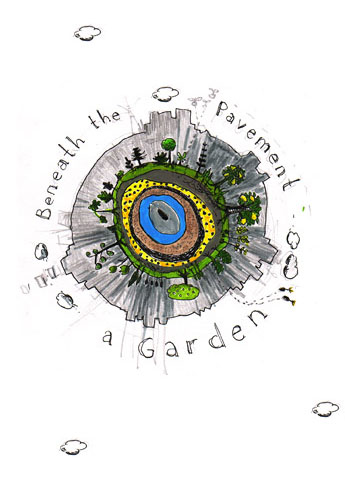 Every so often we will re-publish work which has been printed in limited-edition contexts in projects related to Farm Together Now or by one of the contributors. Today we start by sharing an essay from “Beneath the Pavement: A Garden” which is a project by Amy Franceschini and Myriel Milicevic that was commissioned by Radar at Loughborough University. According to the organizers “Beneath the Pavement considers biological forms in relation to political and social systems”. The project included a garden, some walking tours, performances and a publication from which we will be reprinting this essay, On Gardens and Politics by Brian Duff and Maria Rosales. You can view the entire project here, download the book here, and you can purchase the printed version of this document from Half Letter Press.
On Gardens and Politics
By Brian Duff & Maria Rosales (pdf of the text can be downloaded here)
In the history of political thought, metaphors that associate politics with the activity of gardening have been among the most influential and compellingly articulated. They are also among the most destructive ever devised. In this essay we seek to rehabilitate the metaphor of gardening for politics. While many of the projects documented in this book consider the way that gardens might illustrate political systems, we consider the way the experience of gardening might inform our thinking about the activity of politics – in terms of citizenship in addition to political systems broadly conceived. In particular, we suggest that the activity of gardening is a useful way to conceive of a politics in which citizens can develop profound and deeply rooted commitments to experiments regarding the best way to live in a community with others. These experiments, like gardening, will require hard work, creative thinking, problem solving, and sustained commitment. But most importantly, gardening reminds us that sometimes experiments fail. No matter how carefully we plan and how lovingly we cultivate, disasters occur, and the unpredictable happens – hail falls from the sky, blight appears out of nowhere, and insects quietly devour. We must abandon some plants, pull up roots, and try it a different way next year. These are lessons that we can usefully apply to politics, which works best when citizens feel and act upon deep commitments to a notion of the good, but in which citizens are not fundamentalists regarding their commitments. Instead, they are open to reconsidering them, criticizing them, debating them, and abandoning them for a better approach.
Cultivation and politics in the ancient world
In the Greek polis, the ancient community most influential to subsequent political ideas, the tilling of soil and cultivation of plants played a crucial role in the political imagination. Politics was defined as an activity specifically opposed to the drudgery and perceived predictability of working with the soil. Politics shunned matters of sustenance and necessity, and instead concerned itself with considerations of the great and the glorious. A concern with nature and working the land was associated with slaves and women, whose lives centered upon this sort of work. In Athens, for example, citizens literally entered the space of politics by leaving their small farms and going into the walled center of the city to participate in the responsibilities of politics.
A politics that shunned predictability and necessity in the name of the risky and the glorious resulted in many triumphs. Evidence of Athenian glory remains today, in the Parthenon and other monuments to Athenian glory built in this era, or the profound tragic dramas written by Aeschylus, Sophocles, and Euripides. But this sort of politics also resulted in profound disasters, which helped to trigger a reconsideration of both the garden and the values of cultivation in politics. In particular, a ruinous war with Sparta and her allies triggered a retreat behind city walls where intense crowding contributed to a devastating plague. Pursuing the fight in an effort to reclaim the glory of Athens, the Athenians also became complicit in betrayals and genocide. The pursuit of glory for glory’s sake led Athens to lose her way.
It was in this environment that Plato introduced a new conception of politics that would rehabilitate the concept of careful cultivation associated with gardens. Teaching and theorizing in a garden located outside the city center, Plato’s reorganization of politics centered upon careful cultivation carried out by a wise ruler in possession of a master plan. Plato’s political community, described in his Republic, was modeled on his image of an ideal social organization. These ideal “Forms” are accessible only to the wisest – a ruler (or rulers) who organizes society like a gardener does her plot.
John Kinsman of Family Farm Defenders
Last fall I interviewed John Kinsman of the Family Farm Defenders in a live talk-show type format at the Jane Addams Hull House Museum (check out the video here). The interview is posted below and the booklet made of that interview along with other articles by and about John that I produced for FFD to use as a fundraiser is available here for download: kinsman booklet-final-singlepage-web. Thanks to Irina Contreras for the transcription.

John Kinsman Interview Conducted live by Daniel Tucker at the
Jane Addams Hull House Museum (Chicago, IL)
September 27th, 2011
Daniel Tucker (DT): Your parents farmed during the Great Depression. You have said it was easier for farmers then than it is for farmers now. Why is that?
John Kinsman (JK): At that time, we were diversified farmers. We had cows, pigs and chickens. We raised wheat, oats and barley. And when we didn’t have enough money to buy wonderful white bread, sliced white bread, my god we had to eat wheat bread, we took it to the mill and ground it, hated it and now we love it. And we are looking for it all over. So that is part of how we lived but it was not a problem. And it was a leisurely life, believe it or not. We never worked on Sunday. Nobody in the family had to work out [off farm] to support the farm. A farm now is almost a hobby for some people. The man and the woman have to get a job to support their hobby. My parents were able to go to the world’s fair Chicago in 1933 and this is during the Depression. And I remember my grandmother came and took care of us. I forgot how old I was but not old enough to run the farm. And they did that, my grandparents went to California. And I have a picture of that, my grandma with goggles on, she and Grandpa went on a flight in an open cockpit plane in California and so on. Well, anyway it was a more leisurely time. We ate berries everyday so we picked berries. Wild berries and a few tame ones. I remember the gooseberries especially because they were prickly. And my mother canned them. And now we know that berries are very healthy. But, we had berries for almost twice a day and we ate them fresh or canned. And so, it was a good life in spite of the so-called Depression.
DT: You’ve said that you agree with a recent UN report saying “supporting low carbon and resource preserving small holder farms” is the only kind of agriculture that will cool the planet – in reference to global warming. You have farmed organically since the 60’s but you didn’t always. Can you talk about your transition to organic farming and what you have learned from this approach to agriculture?
JK: Certainly. The UW Madison, the College of Agriculture was the best friend of my father and myself. And as time went on, it was like things were changing. We were getting into technology that we had questions about but we thought we had to do it. You know the story of the frog? You put the frog in water and you turn up the heat a little bit and a little bit more and pretty soon the frog is boiled and it doesn’t even jump out. And this happened to us. And I started using herbicides thinking “well, this will save me a lot of time”. And I ended up in the University Hospital with some serious burns. They would never say what it was because of the research going on. But the doctors said, “What’s your name? What’s your occupation?” “Farmer.” “When was the last time you used herbicides or pesticides?” And the same with the med students who examined me. Same thing, exactly. So I knew what it was and yet there wasn’t ever anything in the records that said what it was. Read more…
A new report has been released addressing the epidemic of Farmer Suicides in India.
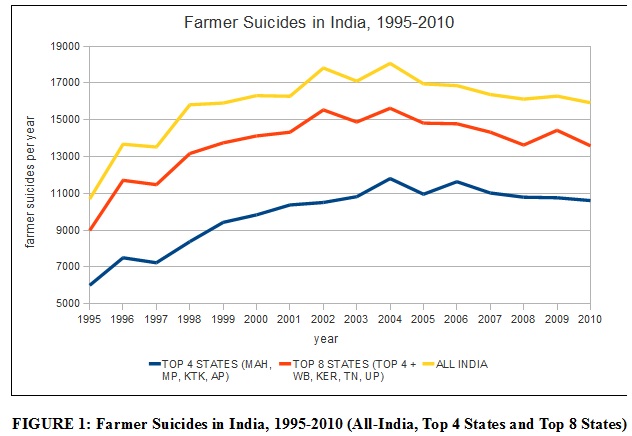
The introduction states:
Since 1995, more than 253,000 farmers have been reported to have committed suicides in India, making this the largest wave of suicides in the world. Other than a few conscientious journalists like P. Sainath and Jaideep Hardikar, the mainstream media has largely ignored this historically unprecedented event. Busy with crafting a palatable picture of “shining” India, the mainstream media has neglected its duty to report on the lives and livelihoods of the largest group of working people in India: farmers. The Indian government’s actions on this issue has been equally, if not more, deplorable. Other than making vapid pronouncements and organizing high-publicity visits of Prime and Chief Ministers to the region, the Central and State governments have done little to ameliorate the conditions of the miserable farmers. No wonder then that the abominable phenomenon of farmer suicides continues with unmitigated ferocity. As a reminder that business-as-usual means disaster for the aam aadmi in Shining India, it was recently reported in the press that a fresh wave of suicides have occurred in various states in India in 2011.
Read the rest of the report by The Sanhati Collective here.
Occupy The Food System
Occupy the Food System
The world can feed itself, without corporate America’s science-experiment crops and expensive chemicals. (reprinted from Other Worlds)
By Jim Goodman

Farmers have been through this before — our lives and livelihoods falling under corporate control. It has been an ongoing process: consolidation of markets; consolidation of seed companies; an ever-widening gap between our costs of production and the prices we receive. Some of us are catching on, getting the picture of the real enemy.
The “99 percent” are awakening to the realization that their lives have fallen under corporate control as well. Add up the jobs lost, the health benefits whittled away, and the unions busted, and the bill for Wall Street’s self-centered greed is taking a toll.

It’s not the immigrants, the homeless, the unions, or the farmers that have looted the economy and driven us to the brink of another Great Depression. The public is catching on.
When Occupy Wall Street (OWS) welcomed the Farmers March to Zuccotti Park in New York on December 4, a natural rural-urban alliance — the Food Justice Movement, gardeners, farmers, seed growers, health care workers, and union members — was formed at Wall Street’s back door.
Change can come only when you confront your oppressors directly on their turf. That makes them uncomfortable, it gets attention, and it wakes up the distracted public.
The Occupy movement is doing exactly what the prominent student activist Mario Savio spoke of in 1964, when he declared: “There comes a time when the operation of the machine becomes so odious, makes you so sick at heart, that you can’t take part, you can’t even passively take part and you’ve got to put your bodies upon the gears and upon the wheels, upon the apparatus and you’ve got to make it stop — and you’ve got to indicate to the people who run it, the people who own it, that unless you’re free, the machine will be prevented from running at all.”
The people who are now forming a movement to occupy the food system agree with this sentiment too.
The food system isn’t working. People eat too many calories, or too few. There’s too much processed food on our plates. Too many Americans lack access to food that is fresh, nutritious, and locally grown. This is the food system that corporate America has given us. It’s the food system it’s selling to the rest of the world.
Clearly, this system doesn’t have the best interests of the public at heart. Nor does it consider the interests of farmers or farm workers or animals or the environment. It has one interest: profit.
We all have to wake up.
Farmers need access to farm credit, a fair mortgage on their land, fair prices for the food they produce, and seeds that aren’t patented by Monsanto or other big corporations. Consumers need to be able to purchase healthy and local food, and to earn a living wage.
The parallels are pointedly exact. It may be the Wall Street banks that are controlling our lives, or it may be Monsanto, Cargill, DuPont, Kraft, or Tyson’s. The system isn’t working.
Why do agribusiness profits continue to grow while farmers struggle to pay their costs of production and more Americans go hungry? We can’t feed our people if we are forced to feed the bank accounts of the 1 percent.
Agribusinesses insist that we have the responsibility of feeding the world. Growing more genetically engineered corn and soy isn’t going to feed the world, nor will it correct the flaws in our food system; clearly it has created many of them.
The world can feed itself, without corporate America’s science-experiment crops and expensive chemicals. The world’s people can feed themselves if we let them — if we stop the corporate land grabs and let them develop their own economies for their own benefit.
The message from the Occupy movement needn’t and shouldn’t be a specific set of demands. It should be about asking the right questions.
Wall Street, the government, and corporate America need to answer one basic question: Why did you sell us down the river?
Jim Goodman is a dairy farmer from Wisconsin and a member of Family Farm Defenders and the National Family Farm Coalition.
Distributed via OtherWords (OtherWords.org)
Economic Localism
Many of the farmers featured in Farm Together Now advocated or demonstrated a kind of economic relocalization as a means to become more connected to their work and each other. There are many parallell attempts. One is the Reimagining Work conference that happened a few weeks ago in Detroit and another is the global Occupy Movement.
Here is a video from Indian activist and scientist Vandana Shiva addressed t the participants at Reimagining Work:
Check out out the Occupy USA Today video by Michelle Fawcett and Arun Gupta on the promotion of localism in the context of Occupy actions across the country.
Food for Thought Exhibition in Southern California

Anne Hamersky on location at Native Seeds/SEARCH in Arizona
Check out this exhibit featuring photographs from Farm Together Now by Anne Hamersky along with some other great food-related art projects at the Wignall Museum of Contemporary Art at Chaffey College in Rancho Cucamonga, CA
Food for Thought: A Question of Consumption
Featuring: Edith Abeyta, Fallen Fruit (David Burns, Matias Viegener and Austin Young), Anne Hamersky, Lauren Kasmer, Mark Menjivar, and Jessica Rath
Curated by Rebecca Trawick
January 17- March 24 Reception for the artists: January 18, 6-8pm In Food for Thought: A Question of Consumption, artists Edith Abeyta, Fallen Fruit (David Burns, Matias Viegener and Austin Young), Anne Hamersky, Lauren Kasmer, Mark Menjivar, and Jessica Rath use food as the impetus to explore food politics and activism in complex ways.
LA-based Edith Abeyta is a visual/performance artist, writer and curator who mines our culture’s fraught relationship with The Black Panther Party in her performative, Panther Lunch Club. A multifaceted installation of outreach, education, and social engagement, the Panther Lunch Club positions artist, Edith Abeyta in the roles of activist and organizer. Inspired by The Black Panther Party’s Service to the People Programs, Abeyta posits that the government has continued to fail us and that we must work cooperatively to change and empower our daily lives when it comes to everyday necessities such as food. Instituting a weekly lunch program in the patio of the museum, Abeyta co-hosts an open free meal with artists, activists, scholars, and representatives from government agencies to discuss the practicalities, politics, access, and solutions to our current food crisis.
Fallen Fruit is an ongoing art collaboration that began with creating maps of the fruit trees growing on or over public property in Los Angeles and other American cities. Their participatory projects have expanded to include Public Fruit Jams in which they invite citizens to bring homegrown or public fruit and join in communal jam-making; Nocturnal Fruit Forages, nighttime neighborhood fruit tours; Public Fruit Tree Adoptions that invite the public to plant trees on the margins of private property. Fallen Fruit’s visual images include an ongoing series of narrative photographs, installations and video works that explore the social and political implications of our relationship to fruit and world around us. The three artists of Fallen Fruit, David Burns, Matias Viegener and Austin Young, think of fruit as the lens by which they look at the world.
Focusing on the farmers who are committed to alternative food systems, Anne Hamersky’s photographs give us access to the farmers who are fighting to maintain small, sustainable agricultural models throughout the United States. The work in Food for Thought: A Question of Consumption comes from a 2009 cross-country trip with San Francisco-based artist Amy Franceshini and Chicago-based documentarian Daniel Tucker. The result of their trip is the compendium Farm Together Now, a book celebrating America’s agricultural revival.
Lauren Kasmer uses textile design, public participatory performances, peoples own recipes and stories about food to investigate our relationship with food and consumption. Kasmer is creating a series of public events and food fete’s to engage us as a community with her installation Thoughtful Food.
Photographer Mark Menjivar explores the interiors of people’s refrigerators in his series You Are What You Eat. Menjivar uses the personal landscape of one’s refrigerator to provide a space to think about what we consume and what those choices mean for us personally and as a society. Menjivar is a Texas-based artist who spent over three years traveling the United States taking photos of diverse Americans and their food.
LA-based Jessica Rath was directly inspired by Pollan’s book and after reading it launched a many-year project that eventually led her to the USDA/Cornell University Plant Genetics Resource Unit where she worked to document the various apple forms and colors found in nature. She’s created a series of porcelain rare apples where she stayed focused on representing their individual types, and a series of large-format photographs of the trees of the USDA/Cornell University Plant Genetics Resource Unit. Raths succeeds in creating scientific portraits and works of art simultaneously in her highly poetic and thought-provoking work.
Visit our website for additional programming to be announced including artist talks, workshops and performances: http://www.chaffey.edu/wignall
Young Farmers
Thanks to the Greenhorns for sharing this:

Young Farmer from the Hunger Coalition in Atlanta, GA - Featured in Farm Together Now
New Survey of 1,000 Young and Beginning Farmers Reveals What the Next Generation Needs
Download Report (PDF)
The National Young Farmer’s Coalition released a study today showing that the nation’s young and beginning farmers face tremendous barriers in starting a farming career. Building a Future With Farmers: Challenges Faced by Young, American Farmers and a National Strategy to Help Them Succeed surveyed 1,000 farmers from across the United States and found that access to capital, access to land and health insurance present the largest obstacles for beginners. Farmers rated farm apprenticeships, local partnerships and Community Supported Agriculture (CSA) as the most valuable programs to help beginners.
“If Congress wants to keep America farming, then they must address the barriers that young people face in getting started,” says Lindsey Lusher Shute, Director of the National Young Farmers’ Coalition. “We need credit opportunities for beginning and diversified farmers, land policies that keep farms affordable for full-time growers and funding for conservation programs.”
Report findings include:
- 78% of farmers ranked “lack of capital” as a top challenge for beginners, with another 40% ranking “access to credit” as the biggest challenge.
- 68% of farmers ranked land access as the biggest challenge faced by beginners.
- 70% of farmers under 30 rented land, as compared to 37% of farmers over 30.
- 74% of farmers ranked apprenticeships as among the most valuable programs for beginners.
- 55% of farmers ranked local partnerships as one of the most valuable programs, and 49% ranked Community Supported Agriculture (CSA) as a top program.
Lack of capital was found to be the biggest challenge for beginners. Although the USDA’s Farm Service Agency offers loans to beginning farmers, current loan rules often disqualify even experienced farmers with good credit and small loans are hard to come by. For real estate transactions, FSA loans take too long to process — up to thirty days to qualify and up to a year to receive funds – and the $300,000 loan limit doesn’t go far in many real estate markets.
Land access was the second biggest concern. Farmers under the age of 30 were significantly more likely to rent land (70%) than those over 30 (37%). Over the last decade, farm real estate values and rents doubled making farm ownership next to impossible for many beginners.
“In Nebraska the main barrier to new and beginning farmers is access to land. Unless an aspiring farmer inherits land, it is very difficult to have access to it,” says William A. Powers, farmer and Executive Director of the Nebraska Sustainable Agriculture Society.
The National Young Farmers’ Coalition recommends action at the local, state and federal level to help beginning farmers. At the local level, communities can create market opportunities for farmers by starting Community Supported Agriculture groups and shopping at farmers markets, as well as protecting existing farmland through zoning and the purchase of development rights. States can preserve farmland and even offer tax credits for farmers that sell their land to beginners. At the federal level, Congress can include the “Beginning Farmers and Ranchers Opportunity Act” in the next Farm Bill, which supports many of the specific recommendations in the report.
Secretary of Agriculture, Tom Vilsack, is calling for hundreds of thousands of new farmers nationwide. Over the past century, the total number of American farmers has declined – from over 6 million in 1910 to just over 2 million today. For each farmer under 35 there are now 6 over 65 and the average age of farmers is 57. The USDA expects that one-quarter (500,000) of all farmers will retire in the next twenty years.
The ‘good food’ movement is inspiring many young people to farm, both from farming and non-farming backgrounds. These farmers have the potential to offset the numbers of retiring farmers and keep family farms active, but land tenure and lack of capital are getting in the way.
“Young farmers are poised to redefine the American landscape along with our food scene”, says Severine vT Fleming, Director of The Greenhorns, “We are strong of will, and determined to make farming sustainable in this country.”
“With the release of reports such as this one, the agrarian revival, this influx of young and beginning farmers, gains status – we’re not just a few people spread across the country, we’re a well organized, politically active group that can be documented,” says Tierney Creech of the Washington State Young Farmers Coalition. “We know who our senators and representatives are, we vote, and our friends and families vote. We need USDA and government support to succeed and we’re going to let the nation know that.”
Download Report (PDF)
Congrats to City Slicker Farms
 City Slicker Farms, one of 20 farms featured in our book Farm Together Now, just celebrated their 10th anniversary! Over 200 guests showed their support last week at the David Brower Center in downtown Berkeley. “With a decade of experience, City Slicker Farms has demonstrated how growing food in the city is a powerful way to bring the community together to address the lack of healthy food in the neighborhood,” said Barbara Finnin, City Slicker Farms’ Executive Director. “Tonight’s event shows how strongly our mission, to empower West Oakland community members to meet the basic need for fresh, healthy food by creating sustainable, high-yield urban farms and backyard gardens, resonates with folks throughout the East Bay.” The event honored ten local heroes who have made a difference in the first decade of City Slicker Farms’ work. The honorees include: City of Oakland Councilmember Nancy Nadel, City of Oakland Director of Parks and Recreation Audree Jones-Taylor, Barbara Christian, Charlotte Banks, Deidre Wan, Empress Diamond Akhanki Buchango, Fulton Brinkley, Jim Martin, Max Cadji, Valorie Rogers Myers and City Slicker Farms Founder Willow Rosenthal.
Listen to this podcast to learn more about their work.

 Farm Together Now - The Book and Blog