Chicago Action Against ‘Traitor’ Joe’s!
- Stagnant, sub-poverty wages
- No right to overtime pay
- No right to organize
- No benefits whatsoever
- Sexual harassment
- In extreme cases, modern-day slavery
Traitor Joe’s has the opportunity to join 9 other corporate food retailers — including Whole Foods, McDonald’s, Taco Bell, Sodexo, Aramark, Burger King and more — who are working with the Coalition of Immokalee Workers to end sub-poverty wages and improve working conditions. The CIW is an internationally recognized human rights organization that fights for the rights of low wage workers in the fields of Florida.
Join us on Sunday, July 17th at 4pm, in front of the Traitor Joe’s on 667 W. Diversey to support farmworkers and to send Joe a strong message: “We expect more of you. Stop being a Traitor!”
Also, there is an Art Party scheduled for Thursday July 14th from 7:30-9:30pm at 3036 N Sawyer. Bring any art supplies you might have and join us for a night of creativity and preparation for Sunday! Feel free to bring music and snacks!! For questions about the art party email chitownfairfood@gmail.com
For more information about this and future events contact Chicago Fair Food by emailing chitownfairfood@gmail.com
To learn more about the Coalition of Immokalee Workers (CIW) visit http://www.ciw-online.org/
And join us on Facebook!! http://www.facebook.com/#!/groups/211530575555923
Calabria to California
Calabria to California is a feature length documentary being directed by Jennifer Kendzior and Vincenzo Candido and featuring Farm Together Now featured farm Freewheelin Farm from Santa Cruz, CA. Check out the trailer below and consider making a donation to their production.
New project! Butchery instructional film series
 A message from our friend at FarmRun:
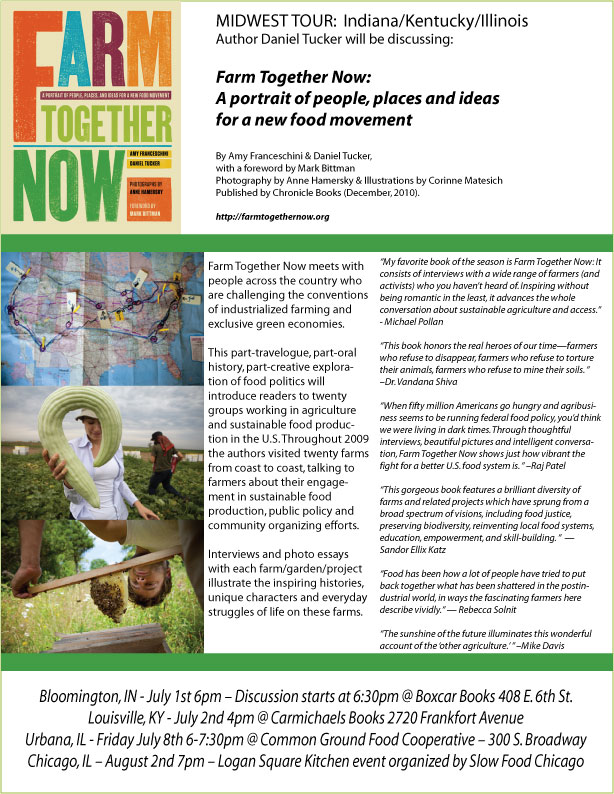 Summer Midwest Tour Starts This Week – Help Us Spread The Word!
- Bloomington, IN – July 1st 6pm – Discussion starts promptly at 6:30pm @ Boxcar Books 408 E. 6th St. RSVP and spread the word on facebook
- Louisville, KY – July 2nd 4pm @ Carmichaels Books 2720 Frankfort Avenue – RSVP and spread the word on facebook
- Urbana, IL – Friday July 8th 6-7:30pm @ Common Ground Food Cooperative – 300 S. Broadway Suite 166 – RSVP and spread the word on facebook
- Chicago, IL – August 2nd 7pm – Logan Square Kitchen event organized by Slow Food Chicago
Join Chicago Author Daniel Tucker for a slide show and discussion of:
Farm Together Now: A portrait of people, places and ideas for a new food movement
By Amy Franceschini & Daniel Tucker, with a foreword by Mark Bittman; Photography by Anne Hamersky & Illustrations by Corinne Matesich; Design by Brian Scott. Published by Chronicle Books (December, 2010).
About the Book: We want to change the way the food system works! Farm Together Now meets with people across the country who are challenging the conventions of industrialized farming and exclusive green economies.Picked by Michael Pollan as his favorite food book of 2010, this part-travelogue, part-oral history, part-creative exploration of food politics will introduce readers to twenty groups working in agriculture and sustainable food production in the U.S. Throughout 2009 the authors visited twenty farms from coast to coast, talking to farmers about their engagement in sustainable food production, public policy and community organizing efforts. Interviews and photo essays with each farm/garden/project illustrate the inspiring histories, unique characters and everyday struggles of life on these farms. It is through sharing diverse voices from the contemporary farm that this book will inspire and cultivate a new wave of agrarians. Half of the author’s profits will be put into a fund to encourage like-minded documentary projects. See reviews from authors Raj Patel, Rebecca Solnitt, Vandana Shiva, Sandor Katz and blogs Real Food for All, Beyond The Plate, Treehugger, Grist, Farmbrarian, Bookslut, Chicago Reader and others here
Watch the trailer here:
Farms featured in the book include: City Slicker Farms (Oakland, CA); Freewheelin’ Farm (Santa Cruz, CA); South Central Farmers Feeding Families (Los Angeles and Bakersfield, CA); Tryon Life Community Farm (Portland, OR); Native Seeds/SEARCH (Patagonia, AZ); Acequiahood of San Luis People’s Ditch/Acequia Institute (San Luis, CO); Georgia Citizens Coalition on Hunger (Atlanta, GA); Mountain Gardens (Burnsville, NC); Jim Knopik (Fullerton, NE); Sandhill Farm (Northeast, MO); AquaRanch (Flanagan, IL); Angelic Organics Learning Center (Caledonia, Rockford and Chicago, IL); Joel Greeno/Family Farm Defenders (Kendall, WI); On The Fly Farms and God’s Gang (Union Pier, MI and Chicago, IL); Participation Park/Baltimore Development Cooperative (Baltimore, MD); Anarchy Apiaries (Hudson Valley, NY); Wild Hive Farm/Cafe/Bakery (Clinton Corners, NY); Nuestras Raices (Holyoke, MA); and Diggers’ Mirth Collective Farm/Intervale Center (Burlington, VT).
Contact farmtogethernow@gmail.com for more information or check out https://farmtogethernow.org/
The Politics of Gardening
 The always wonderful Against The Grain podcast from KPFA in Berkeley, CA has a new episode interviewing the British cultural critic George McKay about his new book Radical Gardening (published by Frances Lincoln). He discusses land, property ownership, environmentalism and community building in a rich historical context they are rarely presented in.
Environmental Journalism Interview with FTN
 Earlier this spring Liz Pacheco from Michigan State University’s Environmental Journalism program, publishers of EJ Magazine, stopped by my office to interview me about Farm Together Now. This interview was pretty different than others I have done because it placed greater emphasis on the process of putting FTN together. Here are some highlights:
EJ Magazine: Where did the initial idea for Farm Together Now come from?
Daniel Tucker: “One thing we talked a lot about when we started the project was that there was an incredible array of food-related literature out in the world that was describing the problems of the food system and creating an analysis. We felt like our contribution could be more. Even if there are occasional articles or spots in a documentary that highlight different sustainable farming practices, there wasn’t really a documentary project that profiled a wide range of people and gave a sense of the diversity and complexity that make up this emerging social movement around food. We’re not experts, we’re not people who can necessarily provide you with the best analysis of what’s wrong with the food system.
EJ: Previous work you’ve done hasn’t been directly tied to the food movement, so why write about food?
DT: ….So, for me, the question is really about what are the most exciting and inspiring, challenging, hopeful social movements that exist in this country right now.
“One answer to that is that food justice, food sovereignty, even slow food [movements] bubbling up across the country are certainly part of an international trend that I look to and I see as undeniably important right now. So, for someone who studies and documents social movements of all varieties—both the unsuccessful ones that are still interesting and worth looking at and the more emerging and vibrant and, lets say, more successful ones—it made sense to orient around a really exciting field, like food activism, that’s happening right now.”
EJ: Are there any places you had wished you had visited, but didn’t?
DT: “We did the best we could with our limited resources, but there are so many places not in the book that it’s hard to pin down. But definitely one place I was curious to go to was Miami. My understanding is a lot of the urban agriculture work happening there is closely connected with activism around fighting evictions. People are making an interesting link between affordable housing and using open space for food production that I think is an unusual mix. A group called Take Back the Land is basically taking back houses that people had been evicted from and putting [those people back] in houses. Then, [Take Back the Land] said if we’re doing stuff around urban land use, then we should also be talking about other things people need, which includes food. And so, they started squatting, taking over empty land and growing their own food. That seemed really exciting to me and I’m sad that we didn’t get to go down there, but their work, in terms of food production, was just starting to take off when we started working on the book……..
EJ: Why did you decide to use the interview format?
DT: “The interview format felt particularly important because we were looking at people experimenting with solutions to the broken food system and we wanted to present their voices as directly as possible. I also personally just love interviews. I’ve done a lot of big interview projects, it’s a format I’m really comfortable with and interested in too. We felt like [the interview format] would also be the most acceptable to people who may or may not have a lot of good experiences with journalists. There’s a lot of fear of being misrepresented…especially among the people who are taking on huge fights, have dedicated their lives to this work, and have risked a lot along the way. That’s a concern I think is shared among a lot of different practitioners, but that I encountered certainly among the people that we interviewed. We felt the interview was a way we could make them most comfortable with the process.”
EJ: What was the editing process like?
DT: “Amy and I did about 10 interviews each, so there are slightly different styles we had to account for in editing to make them seem like they were sort of done in a unified voice. We had 20,000- to 50,000-word transcripts that were amazing documents that I hope sometime we can present excerpts from on our website. The way to make decisions was really to look at the book as a whole. We had to map out the book in terms of issues and key words we felt we had to have in the book. If we felt like there were redundancies across the interviews, then we would eliminate those. Even though we wanted the interview to stand alone, we wanted it also to be a complete project that felt integrated. Really the limitation for us is part of our interest in the way different people in different contexts use different language to talk about very similar things. That was one of the things we were able to experience as authors, but that didn’t come through as much in the book.”
Read the whole interview here.
Color of Food
 Even though it has been out for a few months already, I just came across the report Color of Food produced by the Applied Research Center, the anti-racist publisher of the fantastic Colorlines magazine and website. The unique and noteworthy dimension of this report is that it examines labor in the food system across all of the major industries and sectors. ARC used economic and demographic data from the American Community Survey (ACS) taken over a threeyear period, 2006 to 2008 and focused on the following five food industries:
- Agriculture, fishing and hunting
- Food Manufacturing
- Wholesale Trade of Groceries and Farm Products
- Retail Trade of Food and Beverages
- Food Services
 One of the biggest challenges facing activists working around food justice is access: who can access what and from where? It is about location of places to buy fresh and healthy food options and costs available in those markets. The first mobile food project I heard about was People’s Produce in Oakland, California and it seemed like an obvious and creative response to an obvious problem of access. I am excited to report that just last week in Chicago, where I live, a former public transportation bus was retrofitted for food delivery. The project is called Freshmoves and you can find out more here.
Book Review: Green Gone Wrong
 Book Review: “Green Gone Wrong: How Our Economy Is Undermining the Environmental Revolution” by Heather Rogers (Scribner – April 20, 2010)
Heather Rogers does it again. She writes the book that deals with the topic everyone concerned with ecology knows they should be talking about but doesn’t know how to talk about. Her first book, Gone Tomorrow, dealt with garbage and the uncritical ways we approach recycling and waste creation and “management.” Green Gone Wrong addresses the greening of capitalism and the implications that trying to sell and buy and trade our way through ecological crisis ignores that the logic of our economy is what got us into this mess in the first place (and it is not going to get us out).
The book is structured around case-studies of new so-called “green industries” like natural building, electric cars and organic agriculture. In each case we are presented with contradictions about labor, regulatory and environmental abuses too blatant to ignore. The pattern seems to suggest that the green-capitalist mantra that eco-friendly practices can still be competitive and successful business practices.
As Rogers concludes towards the end of the book “Meaningful transformation requires not just unconventional products, but the creation of an alternative logic, where consuming less would improve the standard of living and where success was defined quite differently.” She continues, “So we can vote with our wallets all we want, but the people with the most money – precisely those who lavishly benefit from a system built on ransacking nature – will inevitably control the most votes. Only when we rethink how and what we value – so that we no longer bas well-being and quality of life on excess production, consumption and wasting – will we truly be able to address global warming and other forms of ecological ruin.”
This book is highly recommended to anyone hoping to make money and do good in the world as well as those who think that is an impossibility.
For more information see heatherrogers.info
Book Review: Methland
 Methland: The Death and Life of an American Small Town
by Nick Redding (Bloomsbury USA – June 9, 2009)
When I saw Methland listed as a top food book of 2010 on grist.org I was surprised and intrigued. I didn’t know squat about meth or small town life, but I knew from traveling the country to work on Farm Together Now that there was a huge difference between thriving boutique-ish small towns that could support high-end sustainably produced food and those still dominated by industrially cultivated commodities which usually supported a few fat-cat landowners and otherwise desperate and failed local economies. Methland describes the latter kind of town. With richly developed characters not often seen in non-fiction, author Nick Redding tells the story of the consolidation of the food industry through the lens of the rise of Meth use, production and circulation in Oelwein, Iowa (and other midwestern towns like it). The analysis is that Meth is a working-person’s drug made by people coerced into long hours in tractor-trailers and meat-packing plants and abandoned farm houses that all reveal once and for all that small towns are quite depressed and no longer able to be ignorantly romanticized. While the author criticizes ag-industry giants like Cargill and Monsanto, he awkwardly acknowledges towards the end of the book that his father is an Iowa farmer who worked his way up the ranks of the Monsanto agricultural biotechnology company based in St. Louis. While this personal history does nothing to discredit the research and facts in the book, it does reveal how real people with real life stories are implicated in destroying our food system. I highly recommend reading Methland for anyone who wants to try-out (or return to) rural life from the city or suburbs. It is a good reminder that whatever you think you are looking for will have to concede to a new rural reality that is hard to change and hard to ignore.
Subsidies for Food Safety Tracing Technologies
Derek Singleton a Market Analyst for Software Advice has recently published an article calling for the government to subsidize technology purchasing and maintenance for food producers falling under new regulations put forth in the Food Safety Modernization Actsigned into law at the start of this year. According to the Huffington Post “The $1.4 billion bill mainly expands the reach and regulatory powers of the Food and Drug Administration. The FDA oversees production of all food products with the exception of meat, poultry and dairy, which fall under the jurisdiction of the U.S. Department of Agriculture.” Singelton argues “Installing a traceability system is downright expensive – in the neighborhood of $200,000. Companies have to purchase an expensive software system, scanners, and register unique ID numbers to trace food throughout the supply chain. Then there is maintenance and support that comes along with it.” He continues “Providing government incentives for traceability systems is not without precedent. Our Canadian neighbors recently implemented the Food Safety and Traceability Initiative. The government set aside $1.3 billion dollars over the next five years and has gotten hundreds of companies to apply for the incentive. This initiative can be used as a template for the success that can be realized when an incentive program is put into place.” Thanks to Singelton for his well researched blog post. My only critique is that many food companies have been scaling up for years from the fields to the processing plants and the dramatic increase in food related illness is their fault. They have been externalizing the costs of unsanitary working and processing conditions for too long and many of those main perpetrators need to pay for all of the costs associated with their mistakes, including the tracing technology. That said, for smaller businesses with no track record of recalls some government help could go a long way if they are going to fall under these new regulations.

 Farm Together Now - The Book and Blog