South Central Farms – Update
Some of you may have heard in the 1990s and early 200s about South Central Farms, some may have heard about their epic eviction, some may have seen it filmed in the wonderful The Garden, or have even read the interview with Tezo from SCF in Farm Together Now about what some of the members have been up to since the eviction. Well the good news is that SCF has a chance to return to Los Angeles. Check out this note from SCF’s facebook page below:
!!!!Take Action TODAY to Save the Farm!!!!
Thank you!
~SCF~
~~~~~~~*~~~~~~~~*~~~~~~~~*~~~~~~~~*~~~~~~~
The South Central Farm/ers: The Dream Reborn
Los Angeles, CA 11 May 2011–Today, the Los Angeles Times editorial board announced its support for restoring the South Central Farm (see below), once a fourteen-acre miracle of family agriculture in the heart of industrial Los Angeles. What the Times isn’t saying here is that the land that was the Farm is in escrow according to reports received by the Farmers, with only four months left to find a way to return the Farm to the community before the land is sold. The Farmers are again relying on Angelinos to come to the aid of the legendary urban farm.
The South Central Farm is one of those rare causes that, in 2006, united Los Angeles across racial and generational divides. Thousands of people, some who had never been to South Central and others who lived there, stood in line side by side to hear Zack de La Rocha and Son De Madera do a benefit concert for the Farm. Tens of thousands contributed time and money to save the agriculture paradise they had “discovered” wedged between the train tracks and the trucking corridor. Word spread around the world and found support from farmers from South Africa to Oaxaca. Day after day, the ordinary and the famous, from Willie Nelson to Ralph Nader to Joan Baez to Danny Glover, made the pilgrimage to the Farm and tasted air that was palpably fresher, cleaner inside the chain link fence. Environmentalists Daryl Hannah, John Quigley, and Julia Butterfly Hill climbed trees and took turns in perches until the sheriffs drove two hook-and-ladder trucks across the crops to pull the tree sitters down. Hundreds who had camped on the land for weeks after the eviction notice were run off, and over forty-four protestors were arrested.
The Farmers’ mission was and remains to provide fresh food to the food desert that is South Central Los Angeles. Today, they truck in food grown on their farm in Bakersfield, but they hold fast to the promise they made to the South Central community and all of Los Angeles back in 2006: Aqui estamos, y no nos vamos. We are here, and we’re not leaving. The Farmers stand ready to restore the Farm.
The fight for green space, for community space, in recent years has coursed from Taylor Yard to the Cornfields to Ballona Wetlands to the South Central Farm. The Farm was a glimmer of beauty, a source of pride for a poor community and for a mostly concrete-covered urban metropolis. The land sits fallow, waiting to be a Farm again. To make that happen in just four months, the Farmers call on all of Los Angeles to help quickly.
The South Central Farmers are asking that everyone who has heard the story of the Farm take two actions now:
1. That you join the Farmers’ mailing list
Time is short, and more actions will be needed, but this is where we start: Save the Farm!
Los Angeles Times Editorial
A South-Central garden spot again?

The urban parcel once cultivated by the South Central Farmers is again available, for a price. It’s worth pursuing a deal with a foundation to get it growing again.
May 12, 2011
Once there was a farm in South Los Angeles that sprouted among warehouses and railroad tracks. In the shadow of downtown skyscrapers, avocado trees and beans and tomatillos took root and gave 350 families a bountiful harvest and a gathering place. But the plot of land at 41st and Alameda — estimated at 14 acres — was not the farmers’ to keep. Allowed to garden there by the city after it took possession under eminent domain, the land was eventually sold back to a previous owner. The farmers could leave — or buy the property from him for about $16 million.

The 2 1/2-year battle that erupted in 2006 played out like an opera.

The South Central Farmers, as the gardeners named themselves, felt betrayed by city politicians. The property owner, Ralph Horowitz, believed — rightly — that he was being unfairly vilified for simply trying to protect his investment. Despite a promise of millions from the Annenberg Foundation, a deal to buy the property and keep the farm going fell through, giving way to the ugly sight of bulldozers plowing crops under.

But life went on. Some farmers moved farther south to land that L.A. City Councilwoman Jan Perry helped them find. Others — who kept the South Central Farmers name — moved to land near Bakersfield, where they continue to grow produce that they sell at farmers’ markets and in several Whole Foods stores. And some quit farming altogether.
Photos: Remembering the fight of the South Central Farmers
Now, nearly five years later, the property that ignited so much drama sits vacant, awash in wild grasses. But it is for sale, and the South Central Farmers want it back.
Nobody is standing in their way. But nobody is helping them either. Horowitz is asking about $18 million for the property. Perry, the City Council member in whose district the parcel lies, says she would like it to go to the buyer who would bring the greatest number of jobs to people in the immediate area.
Like Perry, we want to see the best use of this large parcel — a rare find — as well. And there’s no question that jobs are badly needed in the community. But is someone offering to create a lot of jobs there? As far as we know, in the tortured history of this piece of land over the last 25 years, the most productive use of it was the urban farm that lasted 14 years. No one wins with the land lying empty and fallow.
The South Central Farmers’ proposal should at least be heard out. Hardly diplomats, they have alienated a lot of people over the years. But they love the land, and they have a plan that may improve on the erstwhile farm. “The garden will be an educational and cultural center,” said Tezozomoc, their most vocal representative, who goes by a single name. He promises that it will be more community-oriented than it was, and that the original farmers will not take plots to garden but will open them to other city residents.
A nonprofit organization or foundation would have to finance the purchase and would essentially own the land. Whether theAnnenberg Foundation would get involved again is unclear. The farmers would have to present their request to the foundation anew.
Horowitz, of course, has to act in his best business interest. This may all be moot if he closes an alternative deal on the land. (It’s been on the market for a year.)
Meanwhile, Perry — who is running for mayor — should at least meet with the farmers to hear their proposal and consider whether to advocate for them. She says she supports community gardens and has created two wetland areas in her district. That’s good. But this piece of land is like no other in her district — a sprawling, flat expanse. Many people were heartened by the presence of the urban farm amid the concrete. Perry herself, in a 2003 letter, hailed the garden as “a vibrant oasis.” If a deal with a foundation can be worked out, wouldn’t it be good to have something growing there again?
Copyright © 2011, Los Angeles Times
GMO Update
There is a new campaign from Food Democracy geared towards getting President Obama and Secretary of Agriculture Vilsack to stop new Genetically Modified Organism/GMO seeds from being planted without further research on the ecological impacts they might produce. Get fully updated here and watch this intro video featuring Dr. Don Huber one of the leading scientists researching GMOs today:
Open Source Farming
This is one of the most exciting examples of “DIY/Maker” culture I’ve seen. Check out the intro lecture by Marcin Jakubowski:
http://www.ted.com/talks/marcin_jakubowski.html
for further ideas and inspiration see their main website wiki for Open Source Ecology and join the facebook group here.
Storms in the South
From the Federation of Southern Cooperatives www.federation.coop:
- a. We are reactivating our Federation Rural Training and Research Center, near Epes, Alabama, as a staging and supply storage area for assistance, i.e., food, water, clothing, equipment, supplies, to Tuscaloosa and surrounding rural communities, impacted by the storms (we used our facility in a similar way during the early weeks after Katrina in August/September 2005).
- b. We are making our dormitory and kitchen available (we have 60+ bunk beds) for people coming from outside the area to work on relief and recovery efforts in Tuscaloosa and surrounding areas. The Center is located 50 miles south of Tuscaloosa and provides easy access to these areas, without imposing on people in the direct impact area.
- c. We will be concentrating our direct emergency assistance to families in small rural communities in the Alabama Black Belt counties surrounding Tuscaloosa:
- d. At the Federation’s Rural Training Center, we sustained wind damage, including high-tunnel greenhouse collapsed ($7,000), shingle, siding and gutter damage to buildings ($2,000), food spoiled in cafeteria due to 3 days without electricity ($1,000) and cross fencing for goat demonstration herd destroyed by falling trees ($ 2,000); all of which will need to be repaired or replaced.
- e. Community training and advocacy for community residents and leaders in their rights and benefits under state and Federal programs like FEMA, SBA, USDA, and others, as well as Red Cross, United Way, and others. We found after Katrina that community leaders needed training and instruction in the details of program regulations and filling out paperwork to receive promised benefits from public and private agencies, as well as counteracting racial discrimination by agencies and programs involved in disaster relief. We plan to offer this type of training as soon as feasible and continuing over the rebuilding period.
- f. Utilizing cooperatives and credit unions in making the recovery efforts more inclusive, democratic, equitable and effective. Also learning from the disaster response experience to be more prepared and effective for the next disaster.
- The Federation needs the support and assistance of its members, partners and friends in making this tornado response meaningful, sensitive and successful.
Family Farm Defenders
A few weeks ago Family Farm Defenders came to Chicago to protest the Chicago Mercantile Exchange and I made this little video about the action:
Included in the video is a speech by Joel Greeno, who was featured in our Farm Together Now book.
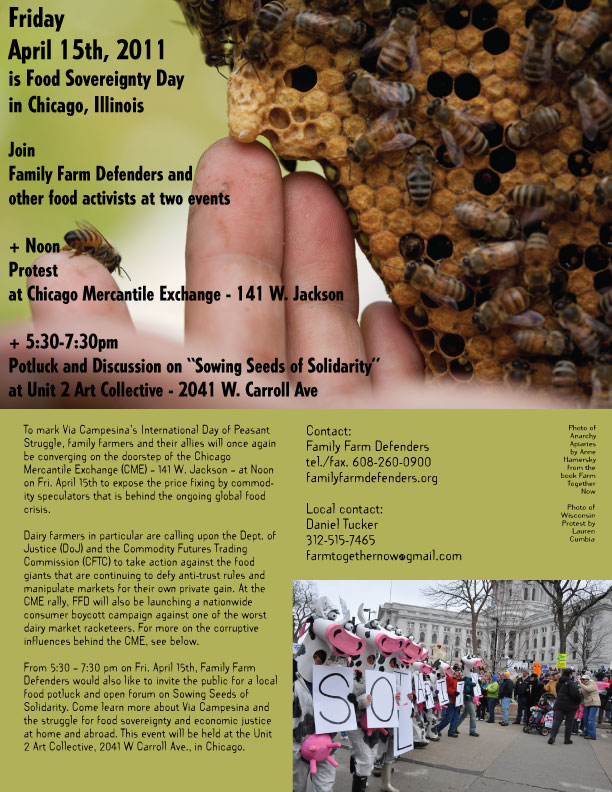
Food Sovereignty Day in Chicago – April 15th
 Forward Widely:
FRIDAY APRIL 15th, 2011
Join Family Farm Defenders for Food Sovereignty day in Chicago, Illinois at TWO events: Protest at Noon at the Chicago Mercantile Exchange (141 W. Jackson) + Potluck and Discussion at 5:30pm at Unit 2 Art Collective (2041 W Carroll Ave)
To mark Via Campesina’s International Day of Peasant Struggle, family farmers and their allies will once again be converging on the doorstep of the Chicago Mercantile Exchange (CME) – 141 W. Jackson – at Noon on Fri. April 15th to expose the price fixing by commodity speculators that is behind the ongoing global food crisis.
Dairy farmers in particular are calling upon the Dept. of Justice (DoJ) and the Commodity Futures Trading Commission (CFTC) to take action against the food giants that are continuing to defy anti-trust rules and manipulate markets for their own private gain. At the CME rally, FFD will also be launching a nationwide consumer boycott campaign against one of the worst dairy market racketeers. For more on the corruptive influences behind the CME, see below.
From 5:30 – 7:30 pm on Fri. April 15th, Family Farm Defenders would also like to invite the public for a local food potluck and open forum on Sowing Seeds of Solidarity. Come learn more about Via Campesina and the struggle for food sovereignty and economic justice at home and abroad. This event will be held at the Unit 2 Art Collective, 2041 W Carroll Ave., in Chicago.
ps. Hear the 7 Principles of Food Sovereignty read by members of the National Family Farm Coalition here: http://www.youtube.com/watch?v=9fYGCHoP-HY
pss. RSVP using the Facebook invite for the protest is here:
http://www.facebook.com/event.php?eid=210899932270227
and RSVP for the potluck/discussion here:
http://www.facebook.com/event.php?eid=175409679176135
Check out this link for more international events happening on April 17th, the International Day of Peasant’s Struggle organized by Via Campesina
Texas Public Radio
I recently spoke about Farm Together Now with Dan Skinner on his Living Green series for Texas Public Radio. Check it out here.

Food for Good Farm at Paul Quinn College

The Food for Good Farm is located on two acres of campus that was once home to the football field of Paul Quinn College located in the Oak Cliff area of Dallas, Texas. The farm is entering its third season on a field where 4 inches of football sod and soil were replaced with truckloads of organic material. Among the items growing on the Farm are corn, tomatoes, blueberries, squash, herbs, bees, and greens. The organic vegetables are used to feed students on the campus, restaurant-goers in Dallas, and local residents via the football field’s former hot dog stand.
Check out this article by Mark Winne on the Food for Good Farm. Meanwhile, some chefs are rallying behind A Community Cooks, a farm dinner where money raised will be used to buy the farm a tractor and help pay for other operating expenses. The dinner will feature herbs, lettuces, and strawberries from the Farm and Will Allen of Milwaukee’s Growing Power will deliver the keynote speech.
Connecting the Dots
This is a re-post from the blog of Chronicle Books, the publisher of Farm Together Now:
Connecting the Dots from Wisconsin, Milk Prices and Farm Together Now
Daniel Tucker


(Wisconsin Tractorcade Photo by Lauren Cumbia)
Last week I went to Wisconsin to show my support to the workers and residents who are trying to keep their right to unionize and dispute the influence of corporate money in influencing elections. I also went to check out Tractorade organized by Family Farm Defenders, an organization featured in the book I recently co-authored: Farm Together Now: A Portrait of People, Places and Ideas for a New Food Movement. Seeing the participation of Wisconsin farmers in the rally in Madison symbolized to me the kind of intersections of concerns that I encountered back in the summer of 2009 when Amy, Anne and I traveled the country working on our book. Interviewing people from Santa Cruz to Atlanta for Farm Together Now confirmed for me that the “food movement” so many of us are talking about is nothing if it doesn’t connect the dots to other parts of life. Food is a lens through which we can talk to all sorts of people about the economy, personal health, workers rights and sustainable care for the earth’s resources.
In Wisconsin I saw Joel Greeno, one of the farmers featured in our book. As usual Joel was coordinating a meeting or discussing what happened at the day’s action on his phone. When we first met in 2009, Joel was protesting the Chicago Mercantile Exchange and the influence that their financial market has on food prices around the world – especially dairy farmers like him and his Family Farm Defender friends. They were making connections between their small town in Wisconsin, food riots in Middle East and Africa, the financial crisis, and food prices at the grocery store. There is no profession that can help us make the links in our human ecology clearer than the farmer.
Presented here is an excerpt of the interview that I did with Joel for Farm Together Now as a way to honor the fight they find themselves in today. Please check out Family Farm Defenders report on Tractorade and support your local farmer as they connect the dots.
Greeno Acres
Kendall, Wisconsin
Organizing body: 1
Scale: 160 acres of pasture
Type: for profit
Key crops: raw milk
In operation: since 1993
Third-generation Wisconsin dairy farmer Joel Greeno has been farming for more than fifteen years and is the current president of the American Raw Milk Producers Pricing Association (ARMPPA), an organization of dairy farmers dedicated to establishing a raw milk price that returns to dairy producers their cost of production plus a profit.
Greeno is also the vice president of Family Farm Defenders, the founder of the Scenic Central Milk Producers Cooperative, and serves on the executive committee of the National Family Farm Coalition (NFFC) as a representative of ARMPPA. NFFC is the U.S. branch of La Via Campesina, the largest farmer organization in the world. These folks make translocal connections between their Wisconsin life and peasant farmers all over the world, often traveling to farmer summits in Europe and Latin America.
Greeno participates in protests and advocacy for farmers’ rights while maintaining a head of forty dairy cows. On top of it all, he steals time to participate in tractor pulls with his friends on the weekends.

Interview with Joel Greeno
Did you grow up on a dairy farm?
Joel Greeno, founder: Oh, yeah. I’ve been milking cows since I was ten years old. But ever since I could walk I was in the barn, doing chores of some kind, or feeding cows or calves. During harvest season, I was bailing hay and unloading hay and mowing hay. I spent all summer putting it up and all winter feeding it up. I bought this place in 1990 and then brought cattle here in ’93. Been farming here ever since.
Could you say a little bit about the land and the context here?
There are a lot of traditional family farms here, and a lot of these farmers pasture one single lot that’s used continuously throughout the summer. But I do rotational grazing, whereby you rotate the cow every few days throughout individual managed paddocks. This way, there isn’t as much fuel going through tractors and equipment, and I cut down on fossil fuel too by not using commercial fertilizers. I’m probably looked at as the oddball because of that.
What motivated you to attend your first meeting around farmer activist work?
In October 1996, “Black Friday” happened: Farmers’ milk prices dropped six dollars a hundredweight over a two-month period—almost a 30 percent drop at the time. It left all farmers in an income crunch, struggling to pay bills. People’s parents were getting put out of business. I began to wonder, “Why?”
In February ’97, I was invited to a meeting of the American Raw Milk Producers Pricing Association. I met John Kinsman, Francis Goodman, and others; joined the organization; and eighteen months later I became president.

What led you to establish the Scenic Central Milk Producers Cooperative?
I recruited a group of farmers who’d agreed to be the interim directors of the co-op, and they filed the articles of incorporation. We were naive to think we could have a co-op up and running in a month or two—we ended up fighting state of Wisconsin red tape for ten months to obtain all of our permits and inspections.
In ten years’ time, we were able to grow from the smallest co-op in the United States to the fortieth largest in the country. We’re very successful in what we do: marketing farmers’ milk, paying top prices, providing excellent services, providing retirement plans in the form of Roth IRAs, Christmas bonuses . . . things to benefit farmers.
What inspired you to join so many organizations and coalitions?
Meeting John Kinsman and also becoming a member of the American Raw Milk Producers (ARMPPA)—and eventually becoming the vice president. Through that organization and Family Farm Defenders, we look at the whole picture; we know we’re not going to fix the milk situation by just dealing with milk. Everything is interwoven, and in order to save dairy farmers, we have to look at all farmers and take on the actions to protect all farmers, whether they are milking cows, organic or conventional, or raising corn and beans.
That’s the nice part of the National Family Farm Coalition: You have a wide range of almost forty farm organizations coming together under a common banner, sharing their problems, and supporting each other. Through the NFFC, we found that contract poultry growers were some of the earliest hit by corporate agriculture, in that you owned a farm but basically owned nothing else. The big corporations would come and say, “We’ll build you facilities, we’ll provide you with feed, we’ll provide you with chickens, you raise those chickens, and then you sell those chickens to us, and this is how much you will make.” But they don’t tell you that if one bird dies, you have to pay for it. Then it went to hogs, then cattle, and dairy was last.
How do commodity brokers and financial spectators affect the price that you get for milk?
There is near direct correlation between what farmers get paid for raw milk and the forty-pound cheddar price on the Chicago Mercantile Exchange, where agricultural commodities are bought, traded, and sold. That cheese market is not supposed to have any impact on my milk market. There is lots of talk that “it’s supply and demand,” but if you take a milk supply line and put it on a graph, and put the dairy farmers’ pay price on that same graph, you have a slow, steady, 1.4 average increase per year in milk production, and farmers’ pay price looks like a heart monitor. There is no correlation.
You basically have a triangle of three that control every aspect of the dairy industry: Kraft Foods, which controls 40 percent of the cheese market; Dean Foods, which controls 40 percent of the fluid market; and Grassland Dairy Products in butter. Each has their turf, and nobody interferes on their turf.

What impact has international networking had on you?
National Family Farm Coalition is affiliated with the international network of La Via Campesina. It makes me feel a little stronger knowing that I have people in other countries who support me, who are fighting the same fight, and, in a lot of cases, we are fighting a common enemy: multinational, transnational companies that are using each country’s unique situation to basically control markets worldwide. We are exposing that by all working altogether.
Those of us who organize here have been extremely impressed with the Movimento dos Trabalhadores Rurais Sem Terra (MST), the landless peasant workers movement in Brazil, and with just how committed they are to the movement. They face being killed, at gunpoint, and still continue the movement even under the worst odds, the worst conditions. They make you hope to someday have that level of commitment. MST has done so much more with less. We need to step it up here. There’s some of us who joke that organizing farmers is kind of like herding cats or trying to keep frogs in a wheelbarrow: You put three in and two escape.
In what ways would you like to see progressive land reform happen in the United States?
Well, it’s always been a good thing that farmers have owned land, but today, most of the land isn’t owned by the people farming it. It’s rented land bought out by companies and real estate brokers and developers. That kind of removes the personal touch, meaning you don’t have the respect for that land as if it were your own. And it tends to lead to management decisions that aren’t in the best interest of food concerns or quality of food—you get into the issues of genetically modified crops, soybeans, and even into the issue of patenting life. Does Monsanto have the right to say, “We now own corn”? Is that right?
How can different sectors of agriculture, and specifically dairy, strike a balance between large- and small-scale operations that work?
Dairy Farmers of America is so big and powerful that it’s able to control markets, cheat markets, and even break the law. You get to be so big that you’re not really held accountable. Our plan with ARMPPA is to have a series of small-run co-ops that work for a select group of farmers and work together through marketing agencies in common (MACs, see page 186). We try to complement and protect one another, not be the big bully on the block. We do everything by cooperation and in the best interest of the farmer and the consumer. We keep things balanced to avoid creating an environment where you benefit by an upswing or a downswing.
Where would you like to see farmers in five years?
I’d like to see more family farms on the land. I’d like to see farmers working together better. Wisconsin used to be covered with successful, small, family cheese operations. We don’t need extreme consolidation in the marketplace; we don’t need plant closures; we don’t need central, larger facilities, because more, smaller facilities will employ more people over a greater area.
Corporate agriculture is not in it for quality. They’re not looking out for the consumer or the farmer; they’re just in it to make money, pure and simple.
People need to recognize the fact that there are only four sources of the world’s raw material: agriculture, forestry, aquaculture, and mining. Agriculture is 70 percent of all raw material. Farmers are absolutely vital, because it’s kind of hard to eat oil or trees; fish is okay, but there is only so much. No matter what, everybody’s got to eat every day or our days are numbered. That’s it in a nutshell.
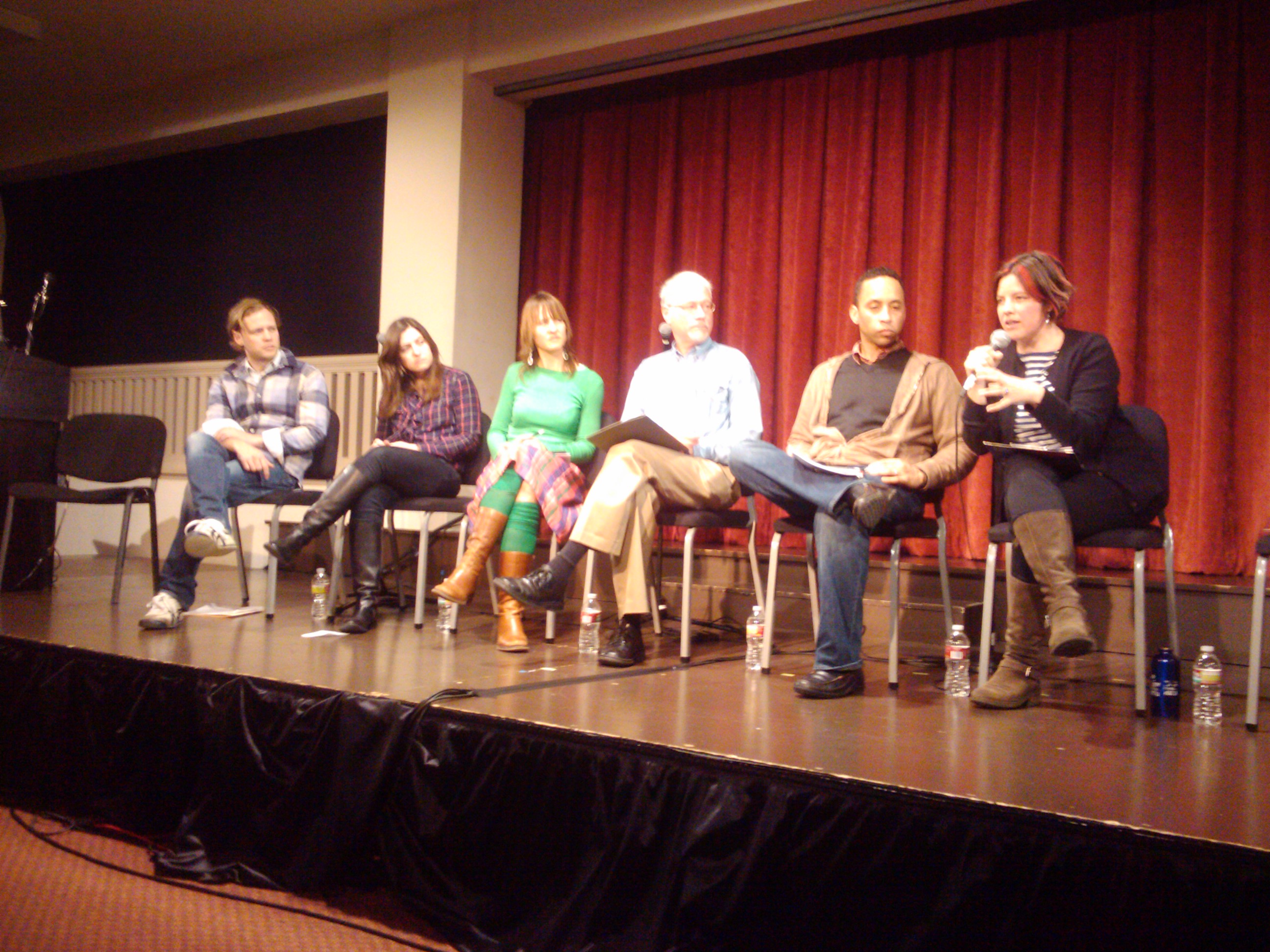
Video from the Seattle release of Farm Together Now
The folks from Pirate TV in Seattle present:
Daniel Tucker: Changing Our Food System, Monday 3/14/11 8-9pm PST, repeats Wednesday at 1pm .
Speakers: + Industrial Harvest – Sarah Kavage http://www.industrialharvest.com/ + University of Washington/Acequia Institute – Devon Pena http://ejfood.blogspot.com/ + Community Alliance for Global Justice – Heather Day (Director) http://www.seattleglobaljustice.org/ + Seattle Tilth Edward B. Hill (Farm Programs Manager) – http://seattletilth.org/ + Alley Cat Acres – Kate Kurtz – http://www.alleycatacres.com/ + Seattle City Council President Richard Conlin Moderated by Onepot/30 Project’s Michael Hebb http://www.onepot.org/
Thanks to Seattle Town Hall & Elliott Bay Book Company
Watch Pirate Television on SCAN Primetime in King County channel 29/77 and streaming online at http://www.scantv.org Mondays 8-9pm & Wed. 12-1pm PST. Pirate TV also streams several times a week on PSA. See http://www.pugetsoundaccess.org

 Farm Together Now - The Book and Blog