John Kinsman
Over the last year I have had the pleasure of interacting with veteran farmer-activist John Kinsman of Lima Ridge, Wisconsin on a number of occasions. First in Washington DC where he contributed to a short video I made with the National Family Farm Coalition based on the 7 principles of Food Sovereignty developed by the Via Campesina network:
Then in April at the annual protests against the Chicago Mercantile Echange led by his group Family Farm Defenders:
And most recently in the form of a live lecture/interview at the Jane Addams Hull House Museum:
In the future, look out for some of my writings on John Kinsman’s work.
*Special thanks to John Peck and Joel Greeno from the Family Farm Defenders.
Growing Power and Wal-Mart
There have been some really provocative dialogues going on ranging from Civil Eats to Grist to Justseeds and Mother Jones about the now-famous urban agriculture group based in Milwaukee Growing Power’s recent acceptance of a huge donation from Wal-Mart. Check out the article in the Chicago Tribune and the response to criticisms from Will Allen (leader of Growing Power).
This is undoubtedly an important debate to have with growing interest in urban and sustainable agriculture from all directions, including those driven primarily by profit. For a great explanation of the challenges presented by corporate “green-washing” see Heather Rogers’ book Green Gone Wrong, which was reviewed on this blog over the summer.
Food Films
 For those of you looking to learn more about food politics, the last couple of years has been rich with relevant documentaries. A new online archive presents some of them in their entirety such as:
- The Coconut Revolution By Dom Rotheroe
- Bullshit By PeA Holmquist and Suzanne Khardalain
- Death On A Factory Farm By Tom Simon and Sarah Teale
- Who Killed The Honey Bee? By James Erskine
- King Corn By Ian Cheney, Curtis Ellis and Aaron Woolf
- Paraguay’s Painful GMO Harvest By Tanya Datta
- The Genetic Conspiracy — Following the Trail By Manfred Ladwig
- The World According to Monsanto By Marie-Monique Robin
- Monsanto — Patent For A Pig By Debbie Melnyk and Rick Caine
- The Future Of Food By Deborah Koons Garcia, Lily Films
- David vs Monsanto By Bertram Verhaag
Hay and Solidarity with Oklahoma
For Immediate Release from our friends at Family Farm Defenders:
Fri. Aug. 19th, 2011
Contacts: John Kinsman Family Farm Defenders #608-986-3815 | Randy Jasper, Family Farm Defenders #608-553-2203 | Joel Morton, Farm Aid #617-354-2922 | Lorette Picciano, Rural Coalition #202-628-7160 | Willard Tillman, executive director, Oklahoma Black Historical Research Project Farmers Co-op #405-201-6624 | Ralph Paige, executive director, Southern Federation of Cooperatives #404-765-0991
Oklahoma is in the grips of its worst drought since the 1920s, and in response Family Farm Defenders, with support from Farm Aid, Rural Coalition, the International Brotherhood of Teamsters, and the Southern Federation of Cooperatives, are organizing an emergency Midwest hay lift.
This rapid response mirrors earlier solidarity efforts which delivered over a dozen Wisconsin tractors to Federation farmers in Mississippi and Louisiana following the destruction of Hurricanes Katrina and Rita.
Wisconsin farmers were compelled to take action after hearing first hand accounts of parched farmland and starving livestock from their Oklahoma colleagues attending the Farm Aid Concert in Kansas City, KS this last weekend.
“If we can get enough hay to some of these farmers to save their animals it may help to save their farms. Desperation sales of livestock are usually a disaster. In the past farmers from other parts of the country rushed hay shipments to help Midwest farmers suffering from a drought. When other farmers face the prospect of being driven off the land we need to do something in solidarity,” said John Kinsman, president of Family Farm Defenders.
“Oklahoma family farmers, and especially, African American and American Indian producers, are very grateful for the support of the producers of Family Farm Defenders and other groups who have stepped up to save our farms in this time of need,” said Willard Tillman, Executive Director of Oklahoma Black Historical Research Project, who is coordinating distribution in OK in cooperation with Randall Ware of the Kiowa Nation.
Livestock auctions in Oklahoma are being overwhelmed as ranchers get rid of their animals before they starve, and these desperation sales are hurting prices for other livestock producers nationwide. Predictions of depressed crop harvests across the Panhandle are also wreaking havoc in the commodity markets.
Teamster truck drivers are being recruited to deliver the hay to Oklahoma from Wisconsin as soon as tractor-trailer trucks can be secured. Hay and other feed supplies will be delivered to 2620 Coltrane Rd. in Oklahoma City.
Any type of quality hay – small bales or large round/square bales – is welcome. Those wishing to donate hay should contact John Kinsman #608-986-3815 or Randy Jasper #608-553-2203 for the exact time and location for drop off.
Financial contributions are also welcome to support the hay lift effort. Send checks to: Family Farm Defenders, P.O. Box 1772, Madison, WI 53701 with “hay lift” in the memo line. FFD is a registered charitable organization so any gift is also tax deductible.
You can also make an online donation towards the Oklahoma Black Historical Research Project’s Disaster Response via the Rural Coalition website: http://ruralco.org/
Recent FTN Reviews and Press

Camping, Summer 2009 while visiting the Acequia Institute in San Luis, CO
It feels like a pretty long time ago in the summer of 2009 when we were wrapping up our farm interviews and starting to edit down the transcripts that ended up becoming Farm Together Now. And now…It seems like the press is slowing down but some great short reviews and blurbs have come in this summer we wanted to draw your attention to. The rest of the reviews are compiled and linked to here.
- Taking Root bloggers reflect on the Seattle FTN book event “What was unusual and heartening about the event was that Daniel Tucker, one of the co-authors, used the talk not merely as a plug for the new book, but as a platform for a discussion about the myriad ways that people can contribute to fixing our food system. In fact, he only briefly introduced the book and read a short excerpt before he turned over the remainder of the event to a panel of people who were all deeply engaged in rethinking our food system…As someone who spends a great deal of time thinking about food, I left the talk with a new sense of how enormous this thing we call “the food system” really is. It’s no wonder that finding problems is so easy and that finding long-term, sustainable solutions can seem so difficult. How can we possibly understand the problems and take meaningful action on issues as varied as water rights, the commodities market, public and private housing policies, transportation, social justice, access to food, the environment, defense, international aid, production of nearly everything we use, and education? I’ve asked myself over and over about how I can be part of finding real, workable solutions. What I’ve decided is to take my cue from the panelists and use my own interests as a gateway to the larger discussion…”
- Food Politics blogger Marion Nestle shouts out FTN and says “The book should inspire anyone to get out and farm.”
- Slow Money Texas blogger Evita Montes discusses FTN and AquaRanch
- Smile Politely interview with Daniel as a preview to a reading of FTN at the Common Ground Food Cooperative
- Rocky Mountain Land Library Recommends FTN
- EJ Magazine interviews Daniel on the process of making FTN
- Earth Eats host Annie Corrigan’s Indiana Public radio interview with Daniel about FTN during a visit to Bloomington (Listen here – scroll to 7:21 – or read the transcript here)
- In My Back Yard host Lisa Bralts on Urbana-Champaign’s WILL AM 580 interviews Daniel about FTN (listen here)
- A few Amazon.com Reader Reviews have come in too:
- Ryan says “I love picking up this book! They say “the best argument is a good example,” and this book really shows why. Every time I read one of its stories I am awed by what people are doing in this country. I love living in the city, but reading this really makes me want to be a farmer. The authors show that I can do both! All the photos are incredible, just like the people they feature…”
- Thomas says “A unique book with an awesome design: Inspiring profiles of people from across the country engaged in the politics of food in the most meaningful ways. Very accessible and very rich. Full of beautiful photographs. This book gives us insight into the work of a range of people from Dairy Farmers in Wisconsin to Urban Gardens in Oakland.”
- Erin says “The interview style of the book as well as the amazing photography make this an intimate and moving look at how local initiatives can make a difference. One goal of Farm Together Now is to illustrate that an even greater impact can be made if we work to farm together. After reading this book that is exactly what you’ll want to do!”
How To Homestead – Join in San Francisco
 Our friends at How To Homestead are gearing back up for the second half of their 11 in 11 tour of San Francisco’s neighborhood cultural centers. Check out the full schedule here. They say:
“From Hunters Point to the Richmond we crisscross this fine city of ours and deliver homestead skill shares during the day and new homestead films at night, and instigate potlucks and folk dancing to boot.”
Our 11 in 11 San Francisco tour resumes this Fall
Check below to see when we will be in your neighborhood.
August 27 District 4 Garden for the Environment
September 10 District 5 African American Art and Culture Complex
September 24 District 1 Richmond District Neighborhood Center
October 15 District 11 Minnie and Lovie Ward Recreation Center
November 5 District 7 St. Mary’s Recreation Center
November 19 District 6 Tenderloin Recreation CenterIf you have any particular skill shares, folk dance and/or films you would like us to feature at the fall shows please let us know by sending an email to: hello@howtohomestead.org.
Co-Op Groceries Are The Best! Tour Report Back
Starting last year at Mess Hall in Chicago we kicked off a slow moving book tour that has included 25 events from Seattle to Louisville to Philadelphia. We’ve had audiences ranging from 7 to 150, though most have been full houses – a testament to the interest in the topic more than anything. The venues have included bookstores, lecture halls, grocery stores, farmer training centers and pie shops. The people who have showed up at these events have been actual farmers, planners, artists and the emerging category of “agri-curious” (thanks to Full and By Farm in Essex, NY for introducing me to this term).
The book has been used widely as a document and networking tool for this emerging food movement that is gaining strength every day. The National Family Farm Coalition bought copies for their members and farms featured in the book have used the attention to do everything from gain new customers and apply for funding to networking and speaking publicly about their work. City Slicker Farms, Devon Pena, Wild Hive Farm/Bakery, Anarchy Apiaries, God’s Gang, On-The-Fly Farm, AquaRanch, Jim Knopik, Freewheelin’ Farm, and Tryon Life Community Farm have all joined us in person at book lectures. Numerous other farm and food projects have come and shared their news and ideas at the events as well. We hope it continues to be useful to future generations through the classrooms which have expressed interest and already started using it in their food related curriculum.
Thanks for your support, for the wonderful reviews, and for coming out to these events. Thanks to the farmers who we profiled for being so open and generous. And thanks especially to the folks at Bloomingfoods (Bloomington, IN) and Common Ground (Urbana, IL), two food co-ops that uses the viral power of their customer receipts to promote our readings. What a great idea! If there is one lesson to be learned by self-organizing a 25 event national tour its that it is hard work to get a room full of engaged people to discuss food politics and farmers stories.
There are murmurs of doing a sequel book in a few years but until then you will have to keep in touch with us through this irregularly updated blog (we are looking for guest bloggers by the way). As life takes new directions, new projects emerge and the enthusiasm around a book being “new” fade – we go back to life as usual and/or newly imagined. Keep in touch!

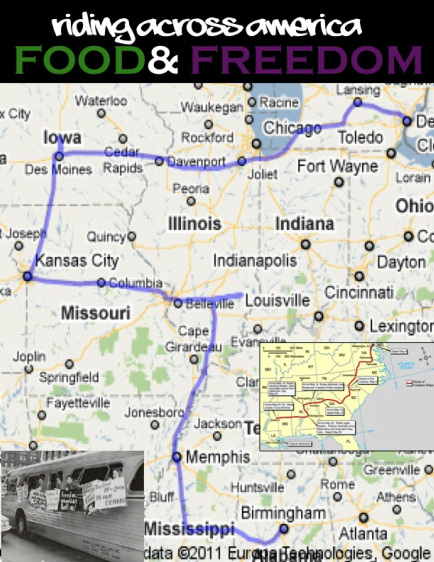
Food and Freedom Ride Begins
The folks from Live Real are organizing their inaugural Food and Freedom Ride which will involve a crew of food-issue activist traveling from Birmingham to Detroit. They write of their journey:
On Sunday August 7th, 13 members of the Live Real community will join Civil Rights leaders in Birmingham, AL to commemorate the 50th anniversary of the Freedom Rides and launch our 12-day journey.Our generation is facing the consequ
ences of a broken food system, and its clear that we’re doing something about it.
On the ride, we’ll meet farmers whose livelihoods have been threatened by Monsanto, meat processing workers facing unfair working conditions, and Native youth who are working to restore traditional foodways. We’ll end our trip celebrating the urban agriculture revival in Detroit.
We’ll also take the Youth Food Bill of Rights on the road, meeting with communities and calling on Congress to take action for a fair 2012 Farm Bill.
And check out a video testimonial from one of their organizers, Hai Vo:
He will be posting videos throughout the trip so check it out.
Off Farm Work
This article was originally published in one of our favorite news sources, Daily Yonder, which deals with rural issues across the US. It isnt often people describe that the only way their farm survives is with one member of the family doing off-farm work. The USDA has generated some research on this subject as well. See the graph below or visit this link for more from their Economic Research Service initiative.
 Home Again: Working to Do Farm Work
We need $2,000 a month, pre tax, beyond what we make on the farm to break even. That means somebody has to work off the farm.
To make a farm work at the start, you need to find work off the farm. I managed to get an editing gig I can do from the house. That allowed Jacob to quit his fulltime job in town.
When we set out to start our farm, that laundry list of challenges facing beginning farmers we’d been hearing so much about became our reality. After years of studying and planning this life in theory, we got to live it.
Access to land was our first hurdle. But we found a landowner willing to give us an affordable lease and we leapt.
Land: Check.
Access to capital was a tricky one, too. But, we found a group of investors willing to put their faith in us and lend us a small amount of money to get us going. And in general, there are many programs, federal and otherwise, built just for farmers like us. Also we’ve been delighted with how eager our local Farm Services Agency and our local lenders have been in working with us.
So, capital: Check.
Two hurdles we’re still working on are equipment and knowledge, but both have been relatively easy to manage. It’s still mighty hard to find small-scale equipment, but it’s there. And we’ve been lucky to set up shop on a place where the landowners and the neighbors are generous with teaching us both the ins and outs of farming in general and the nuances of farming this particular piece of ground, both of which are invaluable. (It doesn’t hurt, either, that I grew up on a farm and my dad, former farmer and a jack-of-all-trades, lives 15 miles away.)
Also, getting a loan for a new tractor or even a grant for new seed-cleaning equipment is within our reach.
So, on the equipment and knowledge question: Still working on them, but let’s put them in the check column.
I don’t mean to make it sound like any of this has been easy to overcome. These are formidable obstacles to be sure. But, we’ve been able to find support for them, mostly because they are on the forefront of the national discussion of how to get more farmers on the land and more food in our communities.
Our real challenge has been perhaps a bit more subtle. It’s also one that is often ignored in the conversation about how to encourage beginning farmers.
It’s what we call the time/labor continuum.
Like so many farmers, we aren’t able to live off the farm income alone (Yet). We need about $2,000 (pre-tax) each month outside farm income to keep us afloat. Health insurance alone for the three of us is $500 a month.
This means finding off-farm work for one, or both, of us.
After our first year of farming, when I worked part-time to float us while Jacob devoted all his time to the farm, it was abundantly clear that we weren’t going to survive another year like that. So, when Jacob was offered a great full-time job, with a steady salary and benefits, we jumped.
I kept my part-time editing work, but devoted more time to the farm and Jacob found a balance between farming and working off the farm.
But as we expanded both our farm and our family (we welcomed a new farmhand last fall), that balance became trickier. Until finally, it became unsustainable.
Jacob’s job was an inspiring, all-consuming kind of job. Mix that with the inspiring, all-consuming job of farming and things start to fall apart.
Although financially, the job gave us the breathing room to farm, it took away our most valuable asset: time.
This winter, it became clear that with a tiny baby in my arms, my farm time was going be more limited than we expected and with Jacob’s 10-hour days and two-hour daily commute, his farm time would be nearly nonexistent.
When the farm started suffering and the family started suffering, we knew we had to make a change.
So, we began looking for other options. There were plenty of avenues for us to get money for land. Plenty of options for us to finance equipment. Even though our other challenges were just that, challenging (marketing, business planning, etc.), we were finding ample support for them.
But, when it came to the never-ending dance between bringing in enough income to live on and still having enough time to build our business, we were, and continue to be, stymied.
It’s not like we can take out a loan so we can pay our rent or apply for a grant to pay for our groceries or health insurance.
One of us had to work. The other had to farm. That was the only way to do it.
It just so happened that just about when the wheels looked like they were about to come off, I stumbled across the perfect part-time, work-from-home, fulfilling editing job with PBS MediaShift.
Prairie Heritage FarmA new iPhone and some old fashioned turkeys. That’s the farm these days.The day I accepted the position, Jacob put in his two-week notice.
We’re now two months into this arrangement and, so far, we’re managing. Money is tight and health insurance is astronomically expensive. But, lucky us, we grow food so our grocery bill (hypothetically, anyway) is lower than the average American’s. And, we have a lot of help on the childcare side. (It pays to live close to grandparents, let me tell you.)
But, it’s scary. And, these next few years — before we’re able to sustain ourselves solely off the farm — are going to get even scarier.
With two and a half seasons under our belts, we can say with surety now that we know we can farm. We also know we can make money farming.
But the big, looming question is: if we’re raising a family and needing to work off the farm, will we have enough time to farm?
The USDA’s Economic Research Service reports that in 2009 almost 45 percent of American farmers and their spouses work off the farm. Almost 45 percent of farmers claim farm or ranch work as their primary job. But, only about 15 percent of farm spouses make the same claim.
So, it’s no surprise that when we get together with other young farm couples and we go around the room introducing ourselves, nearly everyone’s story sounds like this:
“We are the X’s. We run Y head of cattle, have about Z acres of grain and my wife/husband works in town.”
I can’t assume to know why these families find themselves in this predicament, but I know for us, it’s partially me wanting to keep my off-farm career and partially us needing an income stream to, in essence, subsidize our farming. I would guess for many other farm families, that scenario sounds familiar.
For us, finding how the off-farm jobs and the farm fit together is nearly a full-time job in itself. Add to that the daily chores of a modern life and the care and feeding of a family — and it all starts to seem impossible.
I’m often struck by this irony: There is nothing more basic than growing food for a living. But, the complexity that farm families have to navigate to make that “simple” life a possibility is staggering.
I’m not saying it’s anyone’s responsibility but our own to figure this out. The whole point of our operation is to find out how to build a farm that can sustain a modern (but very frugal) family. By mixing in diversification and direct markets and high-value crops, we have hopes we’ll get there.
But, in all this, I’ve learned a simple truth: The modern American life is just unbalanced enough that either our version of “a living” is too expensive or our food system is too broken to give farmers enough money for the food they grow to sustain themselves. Or, more likely, it’s a little of both.
So, when we’re working on clearing the way for new farmers, we have to continue hammering away at the big hurdles: access to land, access to capital, access to knowledge, access to markets and the like. But, we need to look at not only how farm families sustain their farms, but also how they sustain themselves.
Courtney Lowery Cowgill is a writer, editor and farmer. She and her husband run Prairie Heritage Farm, a small farm in Central Montana where they raise vegetables, turkeys and ancient and heritage grains. Her monthly column, Home Again, is about her journey home to rural central Montana, where she is starting over, starting a family and starting a farm.
Earth Eats Podcast and Interview
 Annie Corrigan of Earth Eats recently interviewed me about Farm Together Now and food politics in general. The transcript is pasted below and the audio podcast is available here for download and streaming.
We’re All In This Together
Annie Corrigan: Let’s talk about the some of the folks who piqued my interest. One guy, David Meyers of On-The-Fly Farm in Michigan. There’s a graphic in the book that has a list of the expenses and then the list of income, and it matches up. It’s equal, so no profit for this farm whatsoever. Did you find that a lot of farmers were operating with that budget sheet?
Daniel Tucker: David was unique in that he calculated in his farm business ledger a cost that most people don’t account for, and that is really what drew us to David: a solidarity subsidy. What he means by that is that he’s going to ask urban people he knows in the Chicago area – he’s a farmer in southwestern Michigan just right around the bend of Lake Michigan – he sort of insists or requires that the people who buy his food pay a little extra so he can give a certain percentage of it away in low-income communities throughout the city.
David was the only person in the book that operated that way, though I can say pretty definitely while everyone was had different economic situations, they were all committed in some way to something that might be called solidarity and that they were using food as a tool to basically engage people around a whole host of issues.
AC: I’m curious to talk more about that solidarity fund, where people give a little bit more so that other people can have healthy foods. This seems to be working on a very small scale for this one guy’s farm. Can this work on a large scale? Could this be a large-scale solution for our country’s food system problems?
DT: I don’t think that model is going to scale up pretty big, that’s true. That’s an important thing to recognize. A lot of these experiments work quite well and they’re quite admirable and inspiring on a small scale. Like all economic endeavors, when you start to scale them up, the contradictions start to show through more or the complexities start to show through more. But, that stuff is always there, and it’s just a little easier to work around on a small scale.
I think that some of the models that are introduced in the book can be scaled up, but in particular I would say the people who are organizing themselves as cooperatives. There’s a long history of agricultural and food-related cooperative businesses in the US and that’s something we can draw from. The cooperative structure allows for a subtle but meaningful shift in the way the economics of food or any business work.
Who Gets The Money
AC: Before we get too far away from the economics of food, let’s talk about farm subsidies. Lawmakers are thinking of cutting farm subsidies. From your perspective, is this a good thing for the American food system?
DT: I personally don’t think that subsidies are the problem. I think where the subsidies go and the logic that drives and orients the subsidies is the problem. I think the government has a responsibility to regulate the market – and that’s not a view that everyone shares by any means, but that’s my perspective – but how that regulation takes place is the important detail that has to get worked out. So, if more subsidies could go to encourage smaller scale sustainable agriculture, I think that would be a great thing.
Affecting Food Policy
AC: Now let’s shift gears and go to Oakland, California: City Slicker Farms. It’s three urban farms, and over 100 backyard farms. The book describes the folks that this farm serves as low income; they’re having to deal with high crime, not a lot of jobs or opportunities in their area; and not only that, they have to deal with a lot of pollution and very little access to fresh foods. Let’s talk about the people on that farm.
DT: City Slickers is a really interesting model because unlike a lot of garden projects that exist in urban areas, they really insisted (the organizers) that what they were doing was farming. They weren’t giving people plots so that they could grow a small amount of something to mix in with their meals. They were actually producing on a much larger level and everyone was going to reap the benefits, but everyone was going to work the same lots together instead of breaking it up into little plots which kind of gives you a hodge-podge result. Then the other program they developed was to start encouraging and providing the basic tools for people that wanted to do backyard gardening.
They also have done really innovative things on a policy level with the initiation of the Oakland Food Policy Council, which was I believe the first in the country on a sort of major metropolitan scale, where they actually developed an actual food policy agenda for a city. That’s an idea that has taken off and inspired cities like Chicago where I’m from.
That policy tool set is a really important one because while the food system is integrated across international territories, a lot of the way that distribution could work is going to happen on a really localized scale. And so creating certain subsidies either for markets and corner stores to carry fresh vegetables or for it to be easier for people to turn vacant lots into garden, things like that, that’s going to come from a food policy council on an urban or metropolitan scale, and they really pioneered a lot of that work out in the Bay Area.
Urban Farms As A Cultural Movement
AC: It sounds like also they’re serving a food desert. The USDA released a map that plotted food deserts all over the country. Is this is a solution for food deserts potentially on a larger scales?
DT: Urban farms are a piece of a solution for food deserts, but food deserts are simply a reflection of years of neglect of certain parts of cities across the US and rural areas as well. Creating urban farms in and of themselves isn’t the solution to reversing years of neglect, but it’s a component. I think it’s a powerful component in as much that it provides food but also that it is a symbol, and it’s a symbol that everyone can see, that this land that people said wasn’t worth anything and people didn’t care about for years and years is now in a kind of community controlled production. It’s a productive place and it’s a hopeful place. That’s really important, and that’s something I thought about again and again working on this book: the relationship between work that was sort of changing economic systems and work that was sort of symbolic and more changing the culture of how people relate to each other, how they relate to food, how they relate to the land.
I really think that in order to change the food system you have to carefully consider what kind of transformation you want to see in the market and economic relations as well as the general culture.
Start With Healthy Soil
AC: Let’s talk about the land a little bit. When you’re creating an urban farm, you obviously have to think about what plot of land you’re going to take to create a farm out of. Soil is a living thing, and if you leave it along for a really long time, it might not necessarily be the best soil or best plot of land for growing food. Talk about some people you spoke with who had to re-purpose soil in the city or had a hard time figuring out how to grow food in a certain spot.
DT: Certainly I think it’s a big challenge in urban areas and also rural areas because people have grown the same kind of plants and vegetables on rural farmland for way too long and have not cared for their soil. The group that I interviewed in Central Missouri – Sandhill Farm, which has been there for over 30 years now – when they first got started they made a lot of mistakes, but then they finally realized that actually what they were doing was not farming, they were just growing good healthy soil. They shifted their mentality to put the emphasis on the soil and not necessarily on the bounty, and their farming practices became actually a lot more successful.
The Future Comes Closer To Home
AC: In ten years, where do you see the farming system in this country?
DT: I think if we take advantage of this moment, in ten years we’re going to be eating a lot more food that is produced nearby us and have a lot greater sensitivity to where our food comes from and how far it’s traveled to get to us, and also what is possible in the different climates that we inhabit across this geographically vast country that we live in.
That’s going to happen for two reasons. The more negative reason is because I think it’s just gonna have to happen because food prices are soaring across the world, and the kind of logic that we use to organize how we ship grain and vegetables across oceans, that’s not going to be able to last forever. That’s not to say that’s going to go away entirely, but people are going to have to start prioritizing more local and regional food production for that reason.
Then the more hopeful reason is that I think people are recognizing the real joy in relating to food, each other, land, in a different way that has kind of been forgotten. It’s something that we not only have to get back to in an historical sense, but also think about, “How does a healthy, fair, sustainable, local food system look today when over half the world’s population lives in cities and there’s real economic and environment crises to be concerned about?”
I think people are doing a great job of experimenting with solutions to those kind of challenges right now. I’m hopeful that in order to be to a better place in ten years, people will start to put their heads together and think about some shared principles and values that we can push forward with together.

 Farm Together Now - The Book and Blog